
UPANISHADS
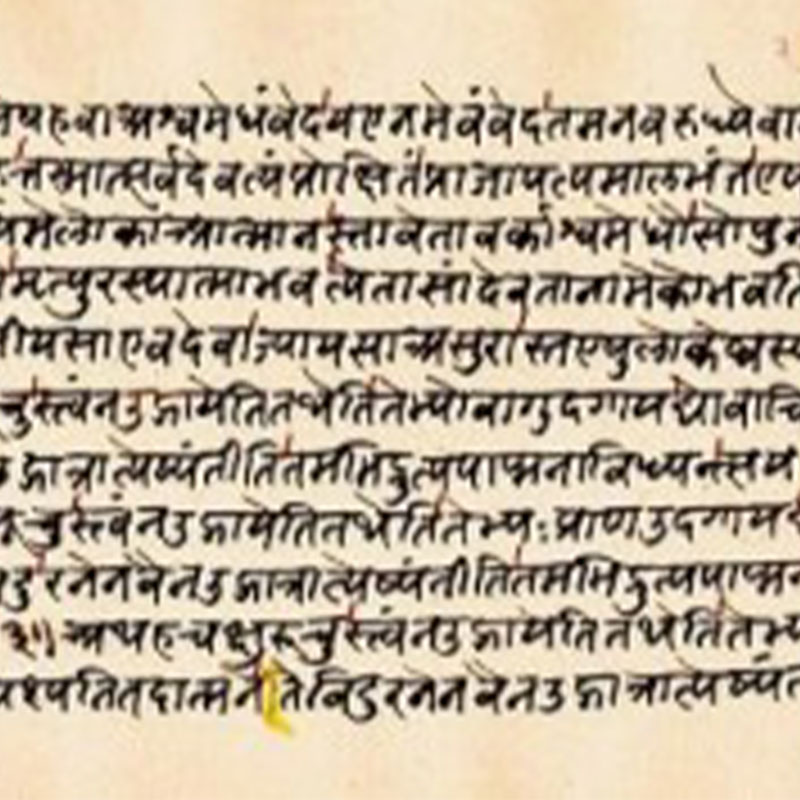
(“https://upload.wikimedia.org/wikipedia/commons/c/cd/Brihadaranyaka_upanishad_adhyaya_1_folio_3b%2C_page_2%2C_Schoenberg_Center_manuscript%2C_Penn_Library.jpg”)
Composed: circa 1200–600 BCE
Notable
- Preservation of Cultural Heritage: Attributed to various sages and philosophers, the Upanishads comprise a profound body of work that emphasized spiritual wisdom, the unity of the individual soul with the universal consciousness, and ethical living, shaping Indian philosophy and religious thought.
- Practical Expression: Utilized philosophical dialogues and meditative insights to address existential questions, guide spiritual practices, and preserve the teachings on dharma, karma, and moksha for future generations.
1200-600 BCE
Documents
The Upanishads are late Vedic (c. 1100–500 BCE) and post-Vedic Sanskrit texts documenting the transition from the previous Vedic ritualism to new religious ideas and institutions. The Upanishads represent emerging central religious concepts in the Hindu religion. The language of the Vedas, Sanskrit, declined and served as a “heritage language” (similar to Latin) after the 12th century CE.
While the Vedas are a collective text (assembled from the 15th century BCE onward), the Upanishads are the most recent addition. Earlier mantras in the Vedas focus on religious ceremony and structure, forming the basis of Hinduism. The Upanishads contribute metaphysical elements such as meditation, philosophy, consciousness, and ontological knowledge. The Upanishads are often called ‘Vedanta,’ which means the end of the Veda: Vedasya antah, the conclusion (Anta) as well as the goal (Anta) of the Vedas. Chronologically, they came at the end of the Vedic period and were taught to pupils at about the end of their course. The chief reason why the Upanishads are called the ‘end of the Veda’ is that they represent the central aim of the Veda and contain the highest and ultimate goal of the Veda as they deal with Moksha, or supreme bliss.
It is difficult to ascertain the exact number that should be regarded as authentic Upanishads; however, many scholars estimate it to be as many as 200. In the Muktika canon, 108 Upanishads are considered canon. The first dozen of these are considered the oldest and most official, known as the principal (mukhya) Upanishads.
(https://en.wikipedia.org/wiki/Upanishads , https://vedicheritage.gov.in/upanishads/)
Original-Language & Textual Contents
Sanskrit Texts: The Upanishads were originally composed in Sanskrit and are embedded in the concluding sections of the Vedas, specifically within the Brahmanas and Aranyakas. The earliest and most authoritative Upanishads, often called the Principal or Mukhya Upanishads, are found in these collections and have been preserved in various recensions.
Critical Editions: The earliest Western editions of the Upanishads date to the 19th century, such as Max Müller’s Sacred Books of the East series (1879), which included the Sanskrit text and English translation of the Principal Upanishads. Modern critical editions often rely on manuscript collation from various regional traditions.
Bṛhadāraṇyaka Upanishad Divided into six adhyāyas (chapters), each containing multiple brāhmaṇas (subsections). (https://www.wisdomlib.org/hinduism/book/the-brihadaranyaka-upanishad) Noteworthy Passages: Madhu Brāhmaṇa (II.5): Explores the interconnectedness of all beings and the world. Dialogue of Yājñavalkya and Maitreyī (II.4, IV.5): Yājñavalkya teaches Maitreyī about the imperishable Self (atman), culminating in the statement, “The Self is to be seen, heard, reflected upon, and meditated upon.” Neti Neti (“Not this, not this”): A method of negation to describe the indescribable Brahman (III.9.26).
Chāndogya Upanishad Contains eight prapāṭhakas (books), each with multiple khaṇḍas (sections). (https://www.wisdomlib.org/hinduism/book/chandogya-upanishad-english) Noteworthy Passages: Tat Tvam Asi (“That Thou Art”): A central teaching repeated throughout Book VI, especially in VI.8.7, expressing the unity of the individual self and ultimate reality. Gayatri Mantra (III.12.1): Revered Vedic hymn and meditation on light and knowledge. Uddālaka and Śvetaketu Dialogue (VI.1–VI.16): Parables and analogies to illustrate the subtlety and pervasiveness of Brahman.
Taittirīya Upanishad Structured in three books (vallis): Śikṣāvallī, Ānandavallī, and Bhṛguvallī. (https://www.wisdomlib.org/hinduism/book/the-taittiriya-upanishad) Noteworthy Passages: Dialogue between Naciketas and Yama: Explores the nature of death, immortality, and the Self. Chariot Allegory (I.3.3–9): The body as a chariot, the intellect as the charioteer, and the Self as the passenger—a classic metaphor for self-mastery.
Influences & Notable For
Vedic Tradition: The Upanishads are the philosophical culmination of the Vedic tradition, emerging as the concluding part of the Vedas (Vedanta). They evolved from earlier Vedic texts, particularly the Brahmanas and Aranyakas, which focused on ritual and sacrificial practices. The Upanishads mark a shift from external ritual to internal spiritual inquiry, emphasizing knowledge (jnana) over ritual (karma). (https://www.britannica.com/topic/Hinduism/The-Upanishads)
Historical/Cultural: Composed between roughly 800 and 500 BCE, the Upanishads arose during a period of significant socio-political and economic change in northern India. The decline of rural tribal society, rise of urban centers, and new kingdoms fostered an environment of intense philosophical and spiritual questioning. This era saw the emergence of world renouncers, ascetics, and forest hermits (sannyasins), whose practices and ideas—such as asceticism and the concept of rebirth—deeply influenced Upanishadic thought. (https://www.britannica.com/topic/Hinduism/The-Upanishads)
Cross-Religious and Global Impact: The Upanishads influenced the development of Buddhism and Jainism, which adopted and adapted concepts like inner purity, self-realization, ultimate reality, and liberation. In the modern era, their translation into Persian, Latin, and European languages brought them to the attention of Western thinkers, impacting figures such as Schopenhauer, T.S. Eliot, and Jack Kerouac. (https://www.worldhistory.org/Upanishads/ , https://en.wikipedia.org/wiki/Upanishads)
Famous quotes
- “Tat Tvam Asi” – “That Thou Art” Citation: Chāndogya Upanishad, 6.8.7 This is one of the four Mahāvākyas (Great Sayings) of the Upanishads, expressing the essential unity of the individual self (atman) and the ultimate reality (Brahman).
- “Aham Brahmasmi” – “I am Brahman” Citation: Bṛhadāraṇyaka Upanishad, 1.4.10 Another Mahāvākya, this phrase declares the realization of the self’s identity with the infinite, a central insight of Vedantic philosophy.
- “Sarvam Khalvidam Brahma” – “All this is Brahman” Citation: Chāndogya Upanishad, 3.14.1 This statement affirms the non-dual vision that everything in the universe is ultimately a manifestation of Brahman, the supreme reality.
Legacy & Modern Significance
The Upanishads have been interpreted as the philosophical heart of Hinduism, shaping Indian thought for over two millennia. Their doctrines of Brahman (ultimate reality) and Atman (the self) have served as the foundation for Vedanta philosophy and have been central to debates on metaphysics, consciousness, and ethics within India. Classical commentators like Śaṅkara, Ramanuja, and Madhva developed distinct schools—Advaita (non-dualism), Vishishtadvaita (qualified non-dualism), and Dvaita (dualism)—each offering different readings of Upanishadic teachings. (https://oll.libertyfund.org/pages/upanishads-and-philosophy) From the 18th century onward, Western scholars and philosophers engaged deeply with the Upanishads. German philosopher Arthur Schopenhauer called them “the most rewarding and elevating reading possible in the world,” and their ideas on the unity of self and cosmos inspired Western metaphysics, ethics, and literature. Max Müller’s translations made the texts accessible, leading to their citation by writers like T.S. Eliot—who famously quoted “Shantih shantih shantih” in The Waste Land—and by artists and novelists such as Herman Hesse. In contemporary times, the Upanishads are frequently invoked by spiritual leaders and authors (e.g., Eckhart Tolle, Deepak Chopra) as sources of wisdom on interconnectedness, mindfulness, and self-realization. Their principles underpin global practices like yoga, meditation, and mindfulness-based therapies, which draw on Upanishadic concepts of inner calm and presence. These integrations have made the Upanishads relevant to personal well-being and holistic health worldwide. (https://apam-napat.com/upanishads-significance/)
Ongoing Debates Interpretive Disputes: Scholars continue to debate the intended meaning of core doctrines, such as whether the Upanishads advocate strict non-dualism or allow for theism and duality. Role in Bhakti: Some Western academics argue that the classical Upanishads do not support the devotional (bhakti) path, leading to discussions about their place in broader Hindu practice. Comparative Philosophy: The Upanishads are often compared with Western philosophical traditions, highlighting parallels with Stoicism, Platonism, and existentialism, while also exposing differences in their approach to self, reality, and ethics.
Modern Moments & Impact on 21st Century
2018, Rashtrapati Bhavan, New Delhi: President Ram Nath Kovind referenced the Upanishads in a national address, describing 21st-century India as a synthesis of the Upanishads and the Internet, at the release of the book Adi Shankaracharya: Hinduism’s Greatest Thinker (April 22, 2018). (https://www.newindianexpress.com/nation/2018/Apr/22/21st-century-india-synthesis-of-both-upanishads-and-internet-president-ram-nath-kovind-1804662.html)
2020, Harvard Divinity School: Hosted the event Vedanta for the 21st Century, featuring lectures and discussions by Hindu monastics and scholars on the contemporary relevance of the Upanishads and Vedanta (March 11, 2020). (https://www.hds.harvard.edu/news/2020/03/19/video-vedanta-21st-century)
2021, Maharishi International University: Launched the online course Upanishads in the Light of Maharishi’s Total Knowledge, Part One, a 12-lesson self-study program focused on the Upanishads’ wisdom in the context of modern knowledge systems. (https://www.miu.edu/upanishads-2021)
2024, Aurobindo Society, Jaipur: Scheduled the Living Veda – Jaipur Edition conference, inviting papers and presentations on modern interpretations of the Veda and Upanishads, with a focus on their relevance to sustainability, governance, and spiritual transformation (December 28, 2024). (https://aurosociety.org/society/viewupcomingevents/1887/Upcoming+Events)
Ongoing: Multiple academic institutions, including Harvard Divinity School and Maharishi International University, offer regular courses, lecture series, and public events explicitly focused on the Upanishads and their application in contemporary society. (https://www.miu.edu/upanishads-2021 , https://www.hds.harvard.edu/news/2020/03/19/video-vedanta-21st-century)
Suggested Reading and Resources
Olivelle, Patrick. The Early Upanishads: Annotated Text and Translation. Oxford: Oxford University Press, 1998. A leading scholarly edition with the Sanskrit text, variant readings, critical apparatus, and a detailed introduction and notes.
Radhakrishnan, S. The Principal Upanishads. HarperCollins Publishers, India, 1994. An authoritative edition with Sanskrit text, English translation, and extensive commentary by a major 20th-century philosopher.
Gambhirananda, Swami (tr.), with Śaṅkara’s Commentary. Eight Upanishads (2 vols.). Advaita Ashrama, 1957–1962. Includes the Devanagari text, English translation, and Śaṅkara’s classic commentaries, widely used in Vedanta studies.
Katz, Vernon, and Thomas Egenes. The Upanishads: A New Translation. New York: TarcherPerigee, 2015. A recent, accessible translation praised for clarity and fidelity to the original, with modern commentary.
Project Gutenberg: The Upanishads by Swami Paramananda (public domain English translation). (http://www.gutenberg.org/ebooks/3283)
Sanskrit Documents: Upanishads (Sanskrit texts and links to translations, digital editions, and commentaries). (https://sanskritdocuments.org/doc_upanishhat/upanishadlinks.html)
Digital Manuscripts Library of India (NMM): Searchable digital facsimiles of Indian manuscripts, including Vedic and Upanishadic texts. (https://www.namami.gov.in/digital-manuscripts-library)
THE VENDANTIC GEMS
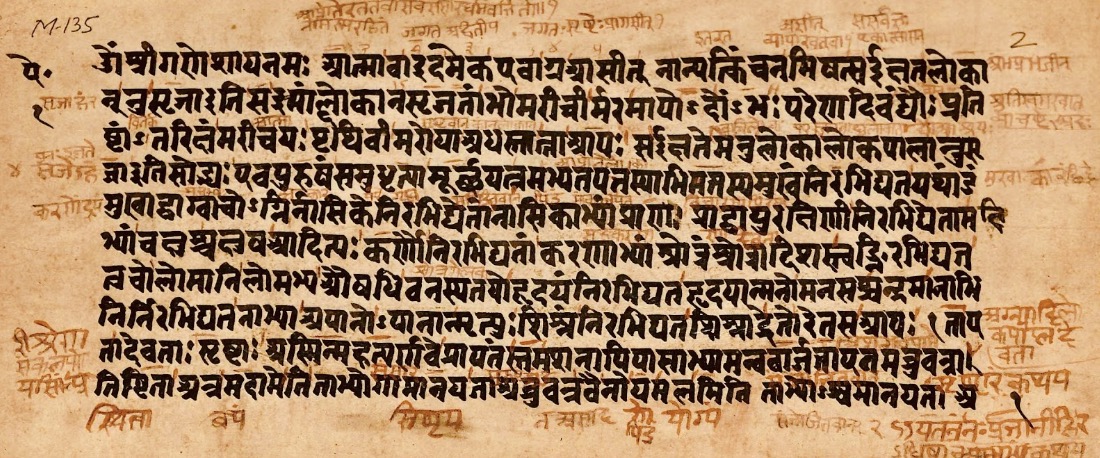
(“File:Aitareya Upanishad, Sanskrit, Rigveda, Devanagari script, 1865 CE manuscript.jpg – Wikimedia Commons.” Photograph, 2010s. https://commons.wikimedia.org/wiki/File:Aitareya_Upanishad,_Sanskrit,_Rigveda,_Devanagari_script,_1865_CE_manuscript.jpg)
An aged paper manuscript page with Sanskrit Devanagari script in black ink, showing insect damage, red markings, and handwritten text.
(Ai-Generated)
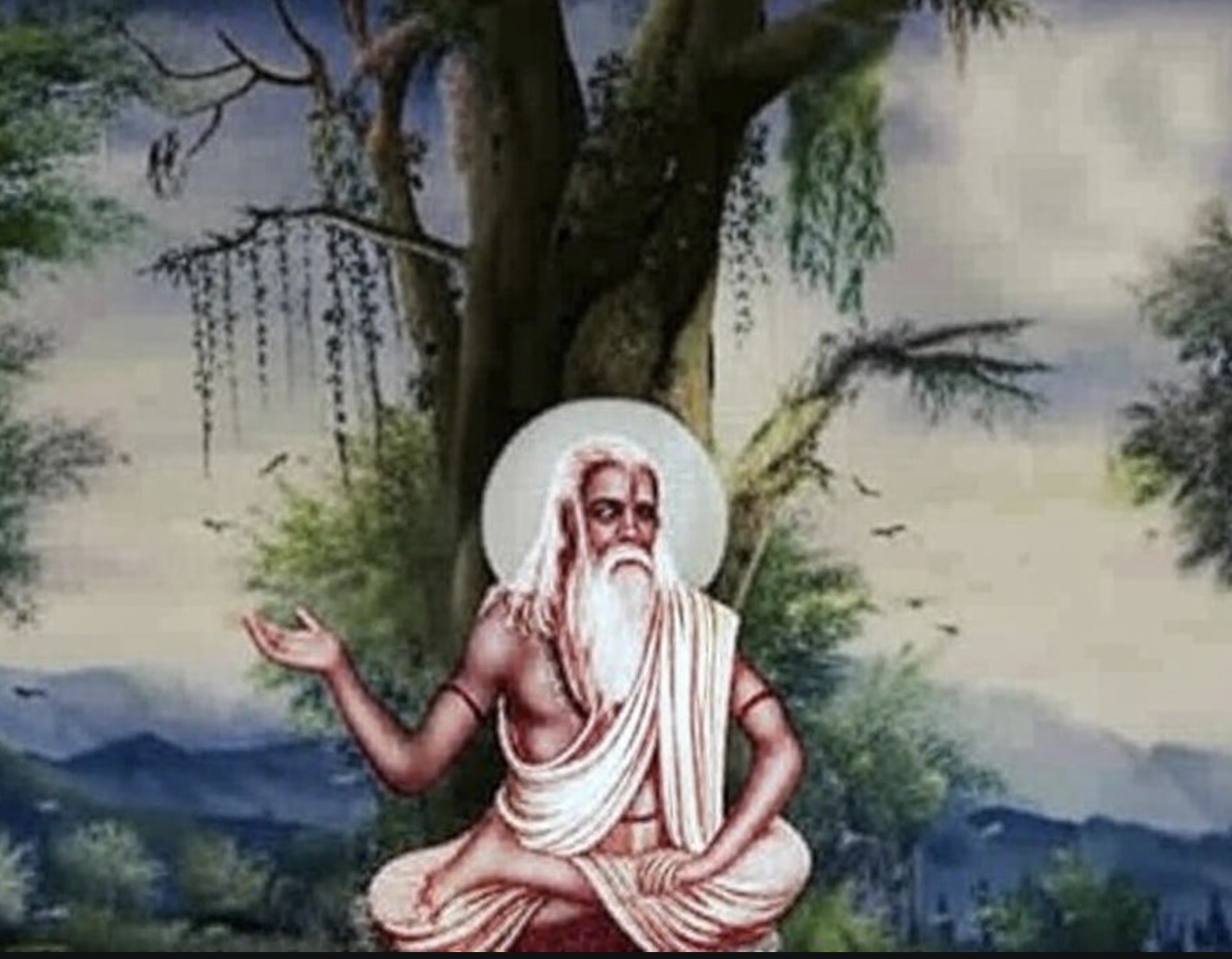
The Upanishads delve into the inner self, exploring the profound connection between the individual soul (Atman) and the universal consciousness (Brahman), offering timeless insights into self-realization and spiritual awakening.
(AI-Generated)
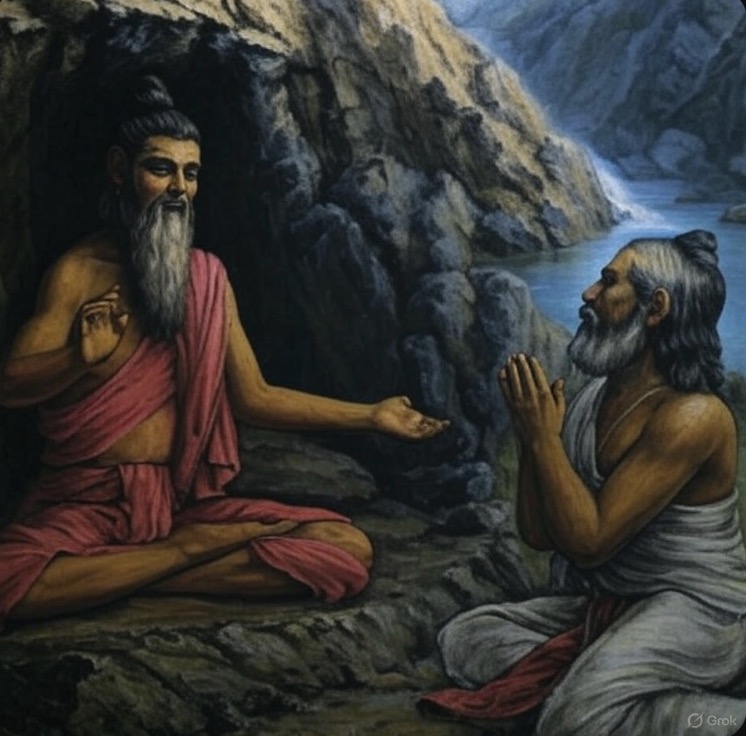
The Upanishads were traditionally communicated orally from teacher (guru) to student (shishya) in ancient India, through a guru-shishya parampara (teacher-disciple tradition).