SOCRATES
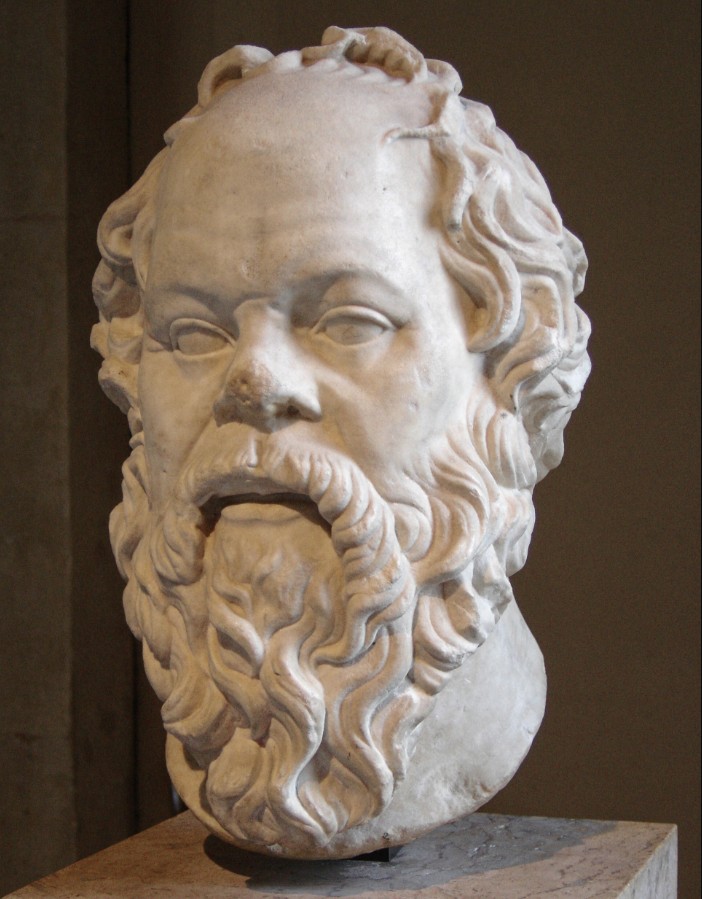
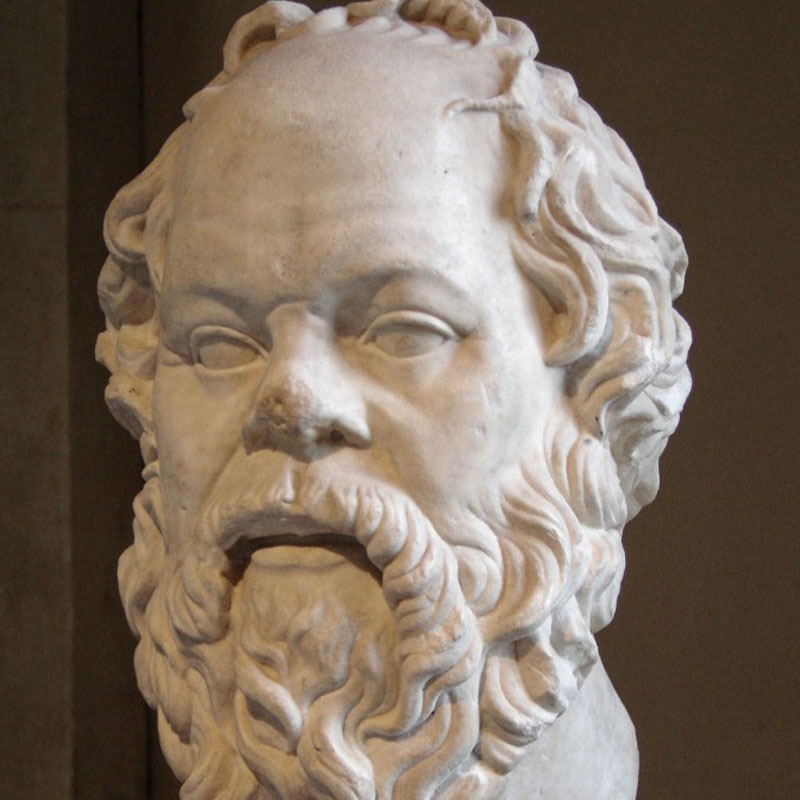
(Lysippos (attributed). Portrait of Socrates. Marble; 33.5 cm high. 1st century AD. Musée du Louvre, Paris. Wikimedia Commons. https://commons.wikimedia.org/wiki/File:Socrates_Louvre.jpg.)
Born: 470 BCE in Deme Alopece, Athens, Greece
Died: 399 BCE (age 71), Athens
Notable
- Socrates is best known for his Socratic method of questioning and his contributions to the field of ethics and moral philosophy.
- His philosophical inquiries focused on fundamental questions about virtue, justice, knowledge, and the nature of the self.
- Socrates’ emphasis on self-examination and the search for truth through dialogue laid the foundation for Western philosophy and influenced later thinkers such as Plato and Aristotle.
- One of the most famous ideas in Socrates’ philosophy is that “the unexamined life is not worth living.”
- Though a controversial figure in his time due to challenging societal norms, he is now remembered as one of the greatest philosophers in history.
470-399 BCE
Biography
Socrates (470–399 BCE) was a classical Greek philosopher who is widely considered one of the foundational figures in Western philosophy. Socrates was born in Athens, and while much of his early life remains lost in history, it is known that his father practiced the trade of a stonemason and his mother worked as a midwife. He spent his life questioning societal norms and beliefs, engaging in deep dialectical conversations with fellow Athenians, seeking to uncover universal truths. Socrates never wrote any of his teachings down; instead, his ideas were passed on orally and later recorded by his disciple Plato in dialogues such as The Republic and Phaedo.
Socrates’ philosophical method, also known as the Socratic method, involved asking deep questions to encourage critical thinking and self-examination (or self-reflection). This approach often led people to recognize the contradictory beliefs they held and to realize their ignorance. Socrates’ relentless pursuit of truth and his strong commitment to his principles ultimately led to his trial and execution in 399 BCE, as he was accused of corrupting the youth of Athens and disrespecting the gods.
Bibliography & Major Works
The primary sources for the philosophical teachings of Socrates are the dialogues written by his student Plato. These dialogues, written in the form of conversations between Socrates and various interlocutors, provide insights into his philosophical ideas and methods. Some of the most well-known dialogues include The Republic, Phaedo, Symposium, and Apology. Other ancient writers such as Xenophon and Aristophanes have also mentioned him in their works.
Xenophon’s book Memorabilia and Apology offer alternative perspectives on Socrates’ life and philosophy. Aristophanes’ comedy The Clouds makes fun of Socrates, highlighting his unconventional teachings and questioning of traditional beliefs. These primary sources provide valuable insights into Socrates’ philosophical inquiries and his impact on ancient Greek society.
Influences & Notable For
Socrates is best known for his Socratic method of questioning and his contributions to the field of ethics and moral philosophy.
His philosophical inquiries focused on fundamental questions about virtue, justice, knowledge, and the nature of the self.
Socrates’ emphasis on self-examination and the search for truth through dialogue laid the foundation for Western philosophy and influenced later thinkers such as Plato and Aristotle.
One of the most famous ideas in Socrates’ philosophy is that “the unexamined life is not worth living.”
Though a controversial figure in his time due to challenging societal norms, he is now remembered as one of the greatest philosophers in history.
Famous quotes
“The only true wisdom is in knowing that you know nothing.” – Plato, Apology, 21d
“Death may be the greatest of all human blessings.” – Plato, Apology, 40c
“An unexamined life is not worth living.” – Plato, Apology, 38a
“All souls are immortal, but the soul of the righteous person is considered both immortal and divine.” – Xenophon, Apology of Socrates, 27
Major Works
Socrates himself did not write teachings of his own. However, his philosophical ideas were recorded by his student Plato in a series of dialogues. Some of the major works attributed to Socrates include:
Plato’s Dialogues: Plato’s major works include Apology, Crito, Phaedo, and Republic, which feature Socrates’ defense speech given during his trial, his final moments before his death, and his philosophical ideas.
Xenophon’s Works: His major works include Memorabilia, Apology, and Symposium. These writings provide various perspectives on Socrates’ philosophy, character, and teachings, which shape our understanding of his teachings and his legacy.
Aristophanes’ Works: Aristophanes’ major work includes The Clouds, a comedic play that mocks Socrates as a foolish philosopher who teaches people to use flawed reasoning and manipulate arguments.
These dialogues provide valuable insights into Socrates’ philosophical method, his views on ethics, politics, and the nature of reality.
Legacy & Modern Significance
Socrates’ legacy in Western philosophy is significant, as he is considered one of the foundational figures in the development of ethical theory, epistemology, and political philosophy.
His emphasis on critical thinking, self-examination, and the search for truth continues to influence contemporary philosophical discourse. Socrates’ curiosity about questioning authority and seeking universal principles of justice and virtue has inspired generations of thinkers to engage critically in philosophical inquiry and moral reflection.
Socrates’ life and teachings have left a lasting impact on the fields of education, psychology, and rhetoric.
The Socratic method, characterized by open-ended questioning and dialogue, has been adopted in various educational settings to foster critical thinking skills and intellectual curiosity.
Socrates’ emphasis on self-knowledge and ethical integrity remains relevant in modern society, as individuals continue to grapple with questions of morality, truth, and the nature of the self.
Modern Moments & Impact on the 21st Century
2000–2010: The Socratic method of questioning was widely used in education, especially philosophy and law classes in colleges and universities, to encourage critical thinking.
2000–2020: Socrates’ method became widely popular in coaching and therapy, such as Cognitive Behavioral Therapy (CBT), where people’s thinking can be changed by asking deep philosophical questions. He also inspired online debate culture, which focused solely on deep questioning.
2000–2020: With the rise of AI and ethics in the tech industry, Socratic ideas about truth, morality, and human nature became more important. People started using Socratic methods to question the role of privacy, technology, and freedom. Academic scholars from various disciplines also began applying his ideas and implications to modern society.
2025 onwards: Socratic methods became widely available in digital resources such as online courses and podcasts to explore Socrates’ philosophy. His method of deep questioning became useful in tackling problems like climate change and social justice. His emphasis on dialogue is also used in resolving conflict and fostering democratic discussions.
Influences & Intellectual Context
Socrates was influenced by earlier Greek philosophers such as Heraclitus, Parmenides, and Anaxagoras, whose ideas shaped his own philosophical thinking. Socrates was primarily interested in ethical questions and the nature of knowledge, seeking to understand the principles that govern human behavior and the pursuit of truth. His method of questioning, known as the Socratic method, was influenced by the dialectical style of the Sophists, who were known for their rhetorical skills and relativistic views on truth.
In the intellectual context of ancient Athens, Socrates stood out for his commitment to pursuing truth through dialogue and his rejection of conventional beliefs without rational justification. His emphasis on self-examination and critical thinking challenged the prevailing assumptions of his time and laid the groundwork for the development of Western philosophy.
Suggested Reading & Resources
Plato, Complete Works of Plato, translated by Benjamin Jowett, Project Gutenberg, http://www.gutenberg.org/ebooks/1656Brickhouse, Thomas, and Nicholas D. Smith. “Socrates.” Stanford Encyclopedia of Philosophy, https://plato.stanford.edu/entries/socrates/
Cooper, John M. Knowledge, Nature, and the Good: Essays on Ancient Philosophy. Princeton University Press, 2004.
Nehamas, Alexander. The Art of Living: Socratic Reflections from Plato to Foucault. University of California Press, 2000.
Vlastos, Gregory. Socrates: Ironist and Moral Philosopher. Cambridge University Press, 1991.
“Socrates,” Stanford Encyclopedia of Philosophy, accessed June 2025, https://plato.stanford.edu/entries/socrates/
Plato, Apology, trans. G.M.A. Grube (Indianapolis: Hackett Publishing Company, 2002).
Xenophon, Memorabilia, trans. Amy L. Bonnette (Ithaca: Cornell University Press, 1994).
Aristophanes, The Clouds, trans. Jeffrey Henderson (Cambridge: Harvard University Press, 1998).
PHILOSOPHER OF WISDOM AND INQUIRY
(Lysippos (attributed). Portrait of Socrates. Marble; 33.5 cm high. 1st century AD. Musée du Louvre, Paris. Wikimedia Commons. https://commons.wikimedia.org/wiki/File:Socrates_Louvre.jpg.)
A marble portrait bust of the ancient Greek philosopher Socrates, likely a Roman copy from the 1st century AD of a lost bronze statue attributed to Lysippos, now housed in the Louvre Museum.
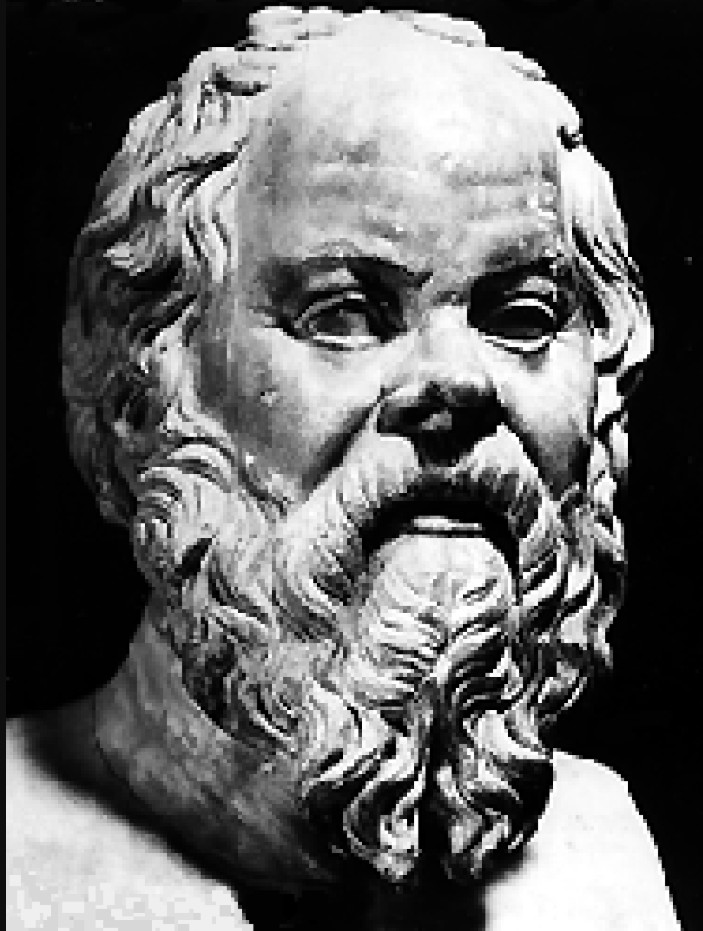
(Unknown. Socrates. Illustration. 1910. Wikimedia Commons. https://commons.wikimedia.org/wiki/File:SOCRATES.png.)
A black-and-white depiction of Socrates based on a classical bust, clipped from the frontispiece of a 1910 edition of the Harvard Classics, emphasizing his thoughtful profile and beard.
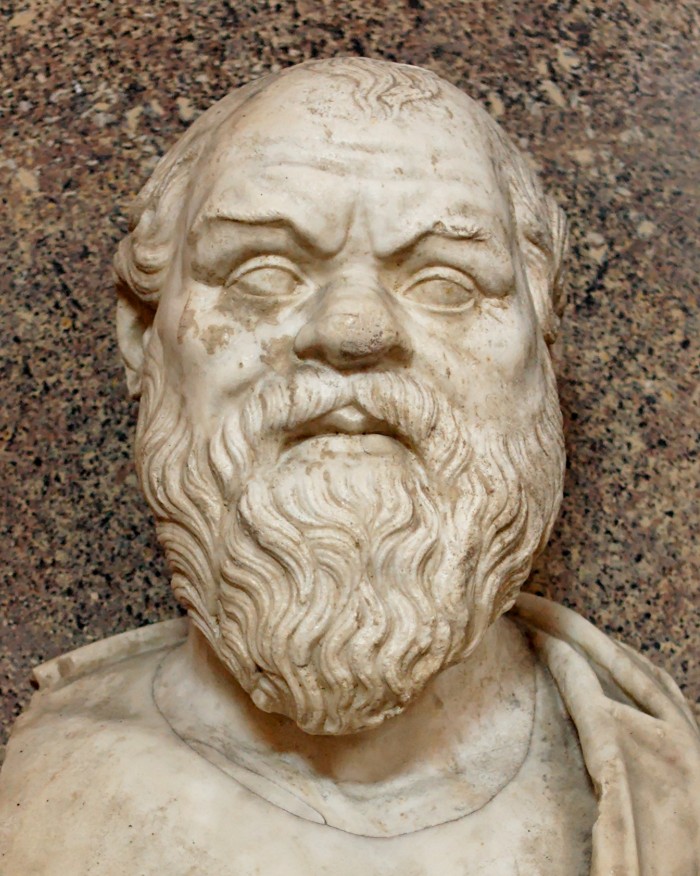
(Unknown. Bust of Socrates. Marble. ca. mid-2nd century AD. Museo Pio-Clementino, Vatican Museums. Wikimedia Commons. https://commons.wikimedia.org/wiki/File:Socrates_Pio-Clementino_Inv314.jpg.)
A marble bust of Socrates, a Roman copy from the mid-2nd century AD after a Greek original from the 4th century BC, discovered at the Quintili Villa on the Via Appia, capturing his iconic features.