Rigveda

RIGVEDA

Rigveda
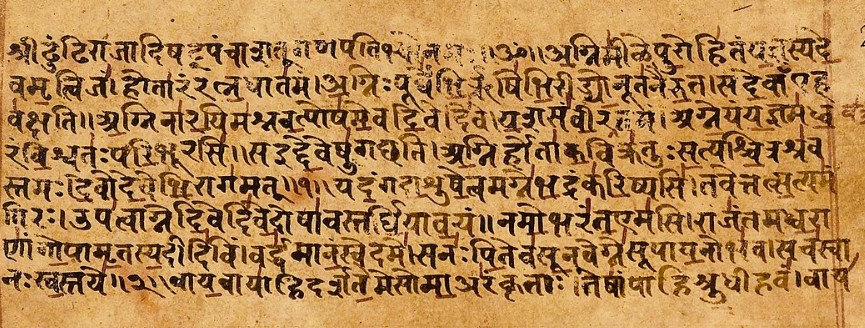
(“https://commons.wikimedia.org/wiki/File:Rigveda_MS2097.jpg”)

Born: ca. 1500 BCE, Northwest India (Punjab region, near the Indus River Valley)

Died: ca. 1200 BCE, Northwest India (early Vedic civilization)

Notable

  • Ancient Scripture: One of the oldest surviving sacred texts and a foundation of Hinduism.

  • Hymns and Deities: Contains hymns to gods such as Agni, Indra, Varuna, and Surya.

  • Poetry and Philosophy: Combines poetic language with early insights into creation and existence.

  • Enduring Influence: Shaped Hindu thought, worship, and literary tradition.

1500-1200 BCE

Biography

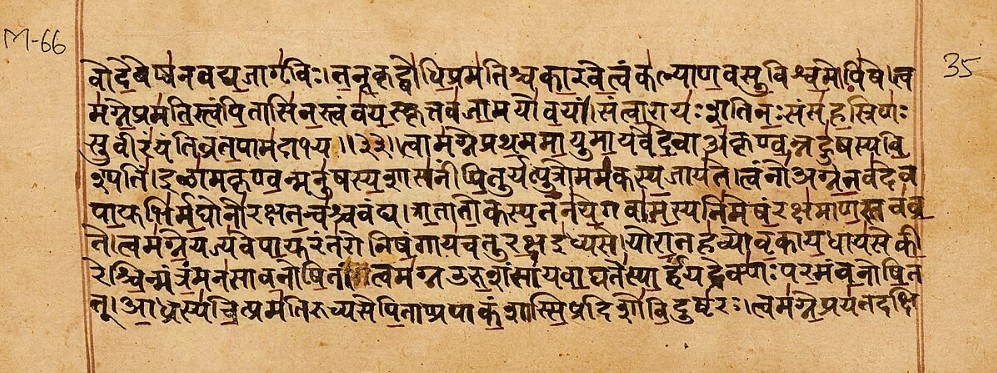
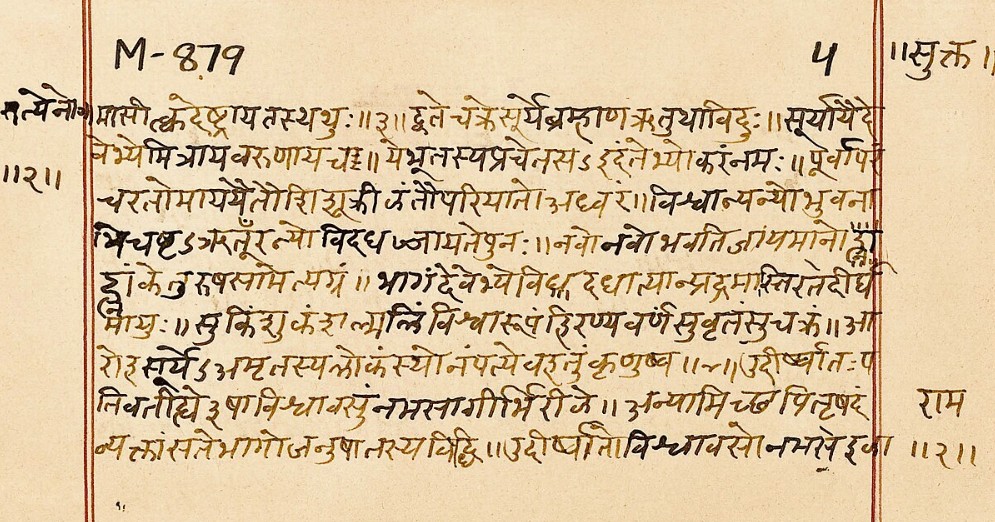
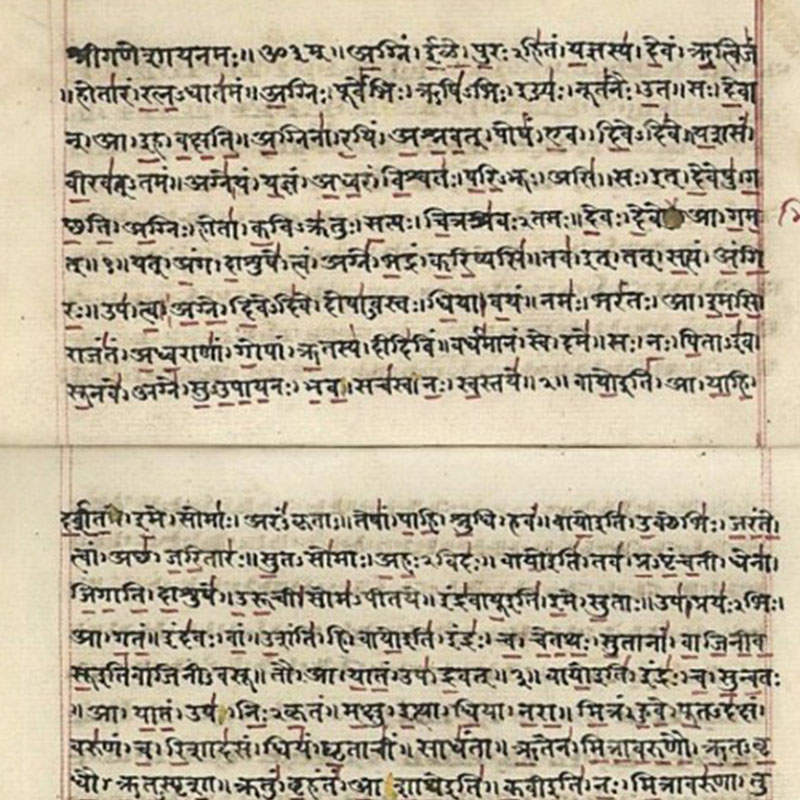
The Rigveda is one of the oldest and most important sacred texts of ancient Indian literature, forming the foundation of Hinduism and Indian culture. Written in Vedic Sanskrit, it is a key part of the Vedas, and it is a collection of over 1,000 hymns divided into ten books (mandalas), which were likely written over a period of several centuries. The Rigveda is considered to be one of the four Vedas, the sacred scriptures of Hinduism, and is believed to have been composed between 1500–1200 BCE by different sages (rishis), although some scholars suggest an earlier date.

The exact origins of the Rigveda are still debated among scholars, but it is generally believed to have been orally transmitted for generations before being written down. Some of the early texts of the Rigveda are among the most ancient surviving texts that still exist in Indo-European languages (like Sanskrit, Greek, Latin, and English). Based on clues and linguistic evidence, most scholars think that the Rigveda was mostly composed in the northwestern part of the Indian subcontinent.

    Bibliography & Major Works

    The primary source for the Rigveda is the sacred text itself, consisting of ten books containing hymns dedicated to various deities. The Rigveda has been preserved in its entirety and has been the subject of extensive scholarly study and analysis.

    Some of the most important editions and translations of the Rigveda are:

    Griffith, Ralph T. H. The Rig Veda. Reprint ed., Kessinger Publishing, 2004.

    Talageri, S. G. (2000). The Rigveda: A Historical Analysis. India: Aditya Prakashan.

    Doniger, W. (2005). The Rig Veda. United Kingdom: Penguin Books Limited.

    Brereton, Joel P., and Jamison, Stephanie W. The Rigveda: A Guide. United States: Oxford University Press, 2020.

    Influences & Notable For

    The Rigveda is known for its ancient heritage as it is considered one of the oldest and earliest surviving texts in the Vedas, making it a foundational sacred scripture in Hinduism. The Rigveda is best known for its hymns, which are dedicated to various deities such as Agni (fire), Indra (weather), Varuna (water), and Surya (sun). These hymns are considered among the oldest religious texts in the world and provide insight into the religious beliefs and practices of ancient Indian civilization. The Rigveda is also notable for its poetic language, philosophical insights about creation and existence, and spiritual practices, which have inspired generations of poets and scholars.

    Famous quotes
    • “Truth is one, though the sages know it as many; God is one, but we can approach him in many ways.” – Rigveda

    • “Let noble thoughts come to us from every side.” – Rigveda

    • “In the beginning of time, there was neither existence nor non-existence.” – Rigveda

    Major Works

    The Rigveda consists of ten books (mandalas), each containing hymns dedicated to various deities. Some of the major themes and topics covered in the Rigveda include the Hymn of Creation, such as the Nasadiya Sukta, which questions the origin of existence, and the Purusha Sukta, which describes cosmic sacrifice. The Rigveda also contains hymns to nature and the elements, praising deities like Agni (fire), Vayu (wind), and Surya (sun), while worshipping the natural forces.

    It provides descriptions of rituals and sacrifices, offering prayers and instructions for pleasing the gods during fire rituals. The Rigveda also contains moral and ethical teachings that encourage resilience, truth, generosity, and guidance on how to live a good and honest life. Additionally, it explores cosmology and metaphysics, diving deeper into the existence of the universe and acknowledging the mystery of existence.

    Legacy & Modern Significance

    The Rigveda has had a lasting legacy on Indian culture and religion, serving as the foundation of Hinduism and influencing the development of Indian philosophy, culture, and literature. The hymns of the Rigveda continue to be recited and studied by Hindus around the world, and its teachings are considered timeless and universal. The Rigveda has also been a source of inspiration for artists, musicians, and scholars for generations, who have drawn upon its themes and motifs in their work.

    The Rigveda reflects the early religious and cultural beliefs and social life of Vedic people in the Indian subcontinent. Its hymns provide insights into ancient rituals, societal beliefs, and reverence for natural forces like Agni (fire), Vayu (wind), and Surya (sun). The Rigveda demonstrates the precision and dedication to spirituality and philosophy of Vedic practitioners.


    Modern Moments & Impact on the 21st Century

    In 2017, a new translation of the Rigveda by Stephanie W. Jamison and Joel P. Brereton was published, providing a fresh perspective on this ancient text. The Rigveda has been the subject of academic conferences and symposiums in the 21st century, where scholars discuss its significance and relevance in the modern world. The texts of the Rigveda are also referenced in modern Vedic texts, Hindu rituals, yoga, and meditation.

    Digital resources such as online databases and archives have made the Rigveda more accessible to a wider audience, allowing people to explore its teachings and insights from anywhere in the world.


    Influences & Intellectual Context

    The Rigveda has had a profound influence on Indian culture and religion, shaping the development of Hinduism and Indian philosophy. The hymns of the Rigveda have been a source of inspiration for generations of poets, philosophers, and scholars, and have played a central role in the formation of Indian literary and intellectual traditions.

    The Rigveda is also believed to have influenced other religious and philosophical traditions in South Asia, including Buddhism and Jainism. The Rigveda has a lasting legacy in Vedic literature, mythology, and spiritual practices. Its philosophical themes and importance are often echoed in the Upanishads and other classical Vedic Indian texts.

    Suggested Reading & Resources

    Jamison, Stephanie W., and Joel P. Brereton. The Rigveda: The Earliest Religious Poetry of India. Oxford University Press, 2014.

    Doniger, Wendy. The Rigveda: Complete. Penguin Classics, 2005.

    Talageri, Shrikant G. The Rigveda: A Historical Analysis. Aditya Prakashan, 2000.

    Hopkins, Thomas J. The Rigveda: A New Translation. Oxford University Press, 1993.

    Griffith, Ralph T. H. The Rig Veda. Elysium Press, 1896.