PLOTINUS
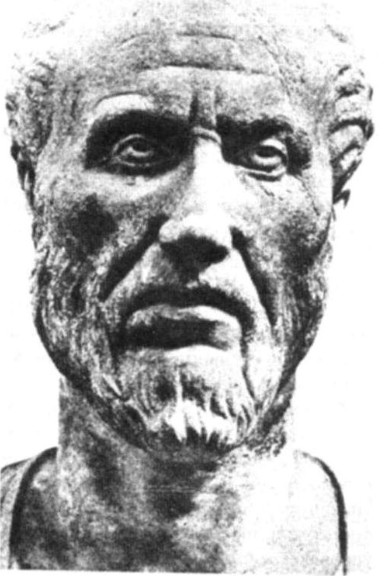
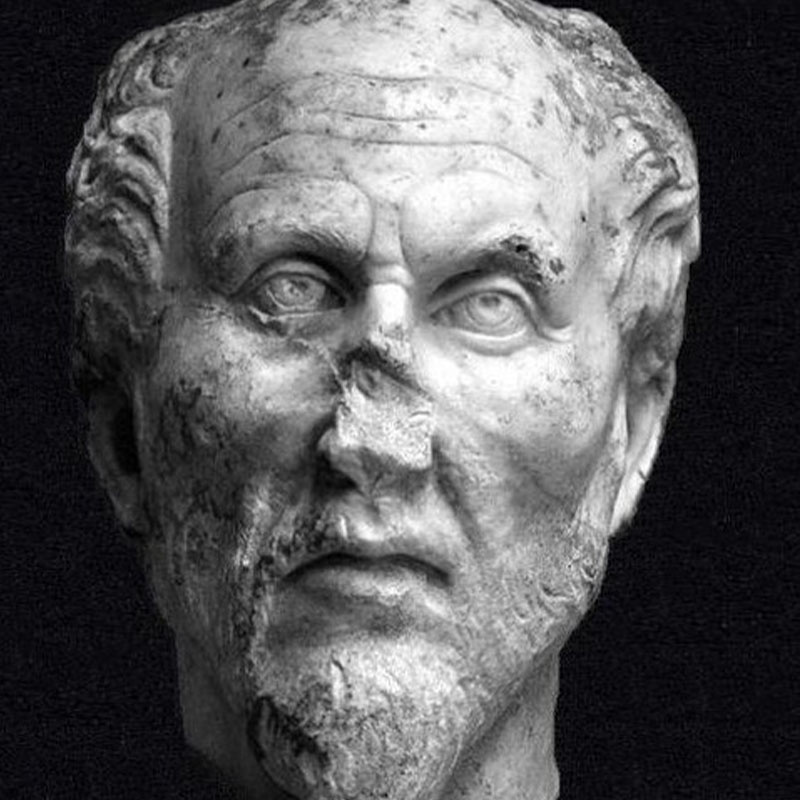
(Unknown Roman sculptor. “Bust of Plotinus.” Marble. 3rd century CE. Archaeological site, Ostia. Wikimedia Commons. https://commons.wikimedia.org/wiki/File:Plotinos.jpg.)
Born: c. 204/5 CE, Lyco or Lycopolis, Egypt
Died: 270 CE, Campania, Italy
Notable
- Founder of Neoplatonism: Developed a systematic philosophical framework based on Plato’s ideas, profoundly influencing later Western thought.
- The Doctrine of the One: Introduced the concept of a transcendent, ineffable source of all reality, known as the One.
- The Enneads: Authored a collection of philosophical treatises, edited by Porphyry, that became foundational texts for Neoplatonism.
- Spiritual Ascent: Emphasized the soul’s journey toward unity with the divine, influencing later mysticism and theology.
204–270 CE
Biography
Plotinus was a Greek philosopher born in Roman Egypt, most likely in Lyco (modern Asyut) or Lycopolis. He is widely recognized as the founder of Neoplatonism, a philosophy that profoundly influenced late antiquity, the Middle Ages, and the Renaissance. Plotinus began studying philosophy in Alexandria at age 28, becoming a devoted student of Ammonius Saccas for eleven years. He joined Emperor Gordian III’s Persian expedition in 243 CE, after which he settled in Rome, where he taught and wrote for over 25 years. His teachings attracted a circle of students and admirers, including his most famous pupil and biographer, Porphyry, who later edited and published Plotinus’s works as the Enneads. Plotinus’s philosophy centers on three fundamental principles: the One (the ultimate source of all reality), the Intellect (Nous), and the Soul. He emphasized the soul’s ascent toward the divine and the unity underlying all existence. His life and thought are primarily known through Porphyry’s Life of Plotinus, which presents him as a figure of remarkable spiritual and moral integrity, largely uninterested in material concerns or personal fame.
Bibliography & Major Works
Major Published Works (Original Editions and Years)
The Enneads (compiled c. 270 CE, published by Porphyry c. 301 CE)
The Enneads are a collection of 54 treatises grouped into six sets of nine (hence the name), edited and arranged thematically by Porphyry after Plotinus’s death.
Key Manuscript and Archaeological Sources
Greek Texts: The authoritative critical Greek edition was published by P. Henry and H.-R. Schwyzer (1951–1973).
English Translations: A.H. Armstrong, Plotinus (Loeb Classical Library, 1966–1988).
Influences & Notable For
-
Founder of Neoplatonism: Developed a systematic philosophical framework based on Plato’s ideas, profoundly influencing later Western thought.
-
The Doctrine of the One: Introduced the concept of a transcendent, ineffable source of all reality, known as the One.
-
The Enneads: Authored a collection of philosophical treatises, edited by Porphyry, that became foundational texts for Neoplatonism.
-
Spiritual Ascent: Emphasized the soul’s journey toward unity with the divine, influencing later mysticism and theology.
Famous quotes
“Life is the flight of the alone to the alone.”
— Enneads VI.9.11“Withdraw into yourself and look. And if you do not find yourself beautiful as yet, do as the creator of a statue that is to be made beautiful; the sculptor cuts away here, smoothes there, makes this line lighter, this other purer, until he or she has shown a beautiful face upon the statue.”
— Enneads I.6.9“Knowledge has three degrees—opinion, science, illumination. The means or instrument of the first is sense; of the second, dialectic; of the third, intuition.”
— Enneads V.9.7
Major Works
The Enneads (c. 270 CE, edited by Porphyry)
Ennead I: Ethical and anthropological treatises (e.g., nature of happiness, virtue, beauty)
Ennead II: Cosmological treatises (e.g., the physical world, matter, and evil)
Ennead III: The sensible world and its principles (e.g., fate, providence, time)
Ennead IV: The Soul (nature, immortality, descent, and ascent)
Ennead V: The Intellect (Nous) and its relation to the One
Ennead VI: The One and metaphysical principles (unity, multiplicity, the Good)
Legacy & Modern Significance
Influence on Christian, Jewish, and Islamic Philosophy: Plotinus’s ideas shaped early Christian theologians (especially Augustine), Jewish thinkers (such as Solomon ibn Gabirol), and Islamic philosophers (notably through the Arabic Theology of Aristotle).
(https://brill.com/downloadpdf/book/edcoll/9789004440685/BP000011.pdf, https://quotessayings.net/authors/plotinus-quotes/, https://projectaugustine.com/theology/confessions-by-st-augustine/the-philosophy-of-plotinus-and-his-influence-on-augustine-and-christian-theology-excerpts-from-diogenes-allens-philosophy-for-understanding-theology/)
Medieval and Renaissance Thought: The Enneads were central to the development of medieval scholasticism and Renaissance humanism.
(https://en.wikipedia.org/wiki/Plotinus, https://plato.stanford.edu/entries/plotinus/, https://iep.utm.edu/plotinus/)
Modern Philosophy and Spirituality: Plotinus’s emphasis on the unity of all existence and the ascent of the soul continues to inspire contemporary spiritual movements and philosophical discussions.
(https://www.numberanalytics.com/blog/plotinus-enduring-legacy-philosophy-of-religion, https://www.cambridge.org/core/books/plotinus-legacy/plotinus-and-modern-scholarship-from-ficino-to-the-twentyfirst-century/982CE17DF53C7695944928D89913C509)
Ongoing Academic Interest: The Enneads remain a subject of scholarly study and debate in philosophy, theology, and classics departments worldwide.
(https://plato.stanford.edu/entries/plotinus/, https://www.numberanalytics.com/blog/plotinus-enduring-legacy-philosophy-of-religion)
Modern Moments & Impact on the 21st Century
Ongoing (2000–Present): The Enneads are included as core readings in philosophy, theology, and classics courses at universities globally (see university syllabi and repositories).
2024: New critical editions and translations of The Enneads published by academic presses, reflecting ongoing scholarly engagement.
2025: Plotinus’s philosophy discussed in contemporary spiritual and philosophical forums, including digital humanities projects and online conferences.
Ongoing: The Enneads are available in public domain digital editions, such as the Christian Classics Ethereal Library and Internet Archive.
Influences & Intellectual Context
Plato: Primary philosophical inspiration; Plotinus saw himself as clarifying Plato’s true intent.
Aristotle: Integrated Aristotelian logic and metaphysics into his system.
Ammonius Saccas: Personal teacher and key influence in Alexandria.
Stoicism, Neopythagoreanism, Gnosticism: Engaged with and responded to these schools throughout his works.
Suggested Reading & Resources
Secondary Literature (Scholarship)
Armstrong, A.H. Plotinus (Loeb Classical Library, 1966–1988).
Gerson, Lloyd P. Plotinus (Routledge, 1994).
O’Meara, Dominic J. Plotinus: An Introduction to the Enneads (Oxford University Press, 1993).
Remes, Pauliina. Plotinus on Self: The Philosophy of the ‘We’ (Cambridge University Press, 2007).
The Cambridge Companion to Plotinus, ed. Lloyd P. Gerson (Cambridge University Press, 1996).
Archival or Online Sources
Plotinus, “The Enneads” (Christian Classics Ethereal Library)
Plotinus, “The Enneads” (Internet Archive)
Stanford Encyclopedia of Philosophy: Plotinus
Internet Encyclopedia of Philosophy: Plotinus
Cambridge University Press – Bibliography
FOUNDER OF NEOPLATONISM
(Unknown Roman sculptor. “Bust of Plotinus.” Marble. Circa 250–270 CE. Archaeological Museum, Ostia. Wikimedia Commons. https://commons.wikimedia.org/wiki/File:Plotin.jpg.)
A 3rd-century marble bust from Ostia Antica, believed to represent the Neoplatonist philosopher Plotinus, with a bearded, introspective expression evoking contemplative wisdom.
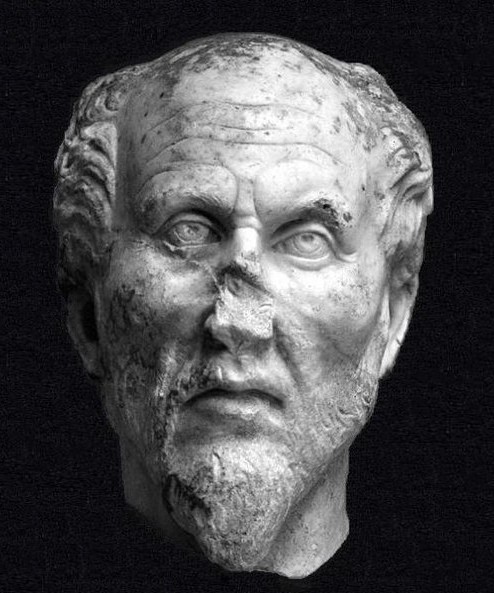
(Unknown Roman sculptor. “Bust of Plotinus.” Marble. 3rd century CE. Archaeological site, Ostia. Wikimedia Commons. https://commons.wikimedia.org/wiki/File:Plotinos.jpg.)
Another Roman-era portrait bust of Plotinus discovered in Ostia, featuring detailed drapery and a serene gaze, capturing the essence of Enneads philosophy.
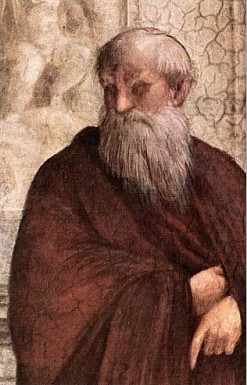
(Raphael. “Portrait of Plotinus.” Oil on panel. Circa 1509–1511. Vatican Museums, Rome. Wikimedia Commons. https://commons.wikimedia.org/wiki/File:Plotinus2.jpg.)
A Renaissance painting by Raphael depicting Plotinus in profile, surrounded by classical elements, symbolizing his influence on later philosophical thought.