
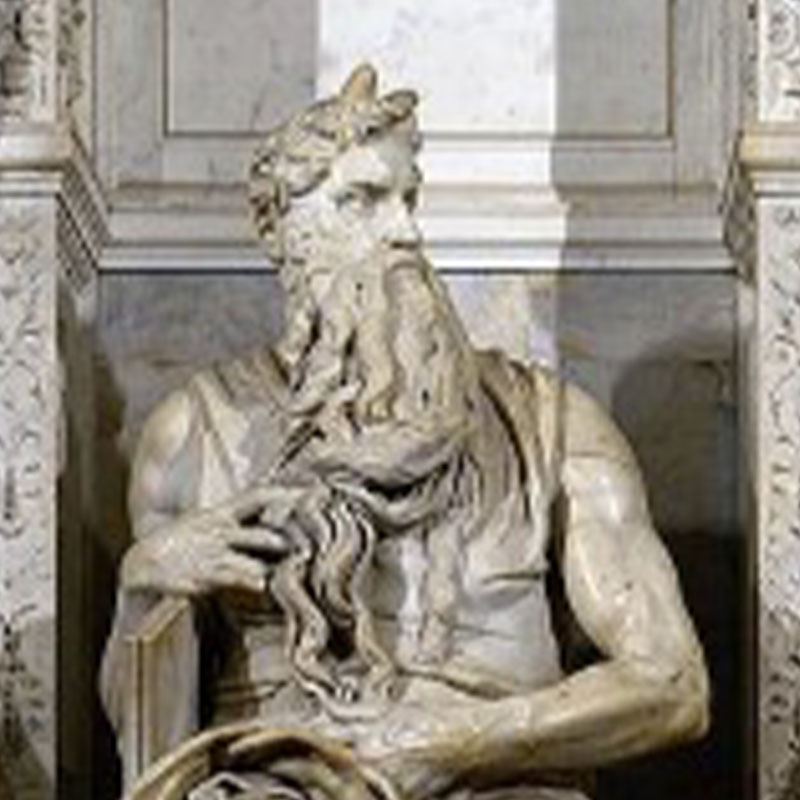
MOSES
“Moses (Michelangelo) – Wikipedia.” Photograph, 2000s. https://en.wikipedia.org/wiki/Moses_(Michelangelo) (accessed October 4, 2025).
Born: ca. 1391 BCE, Land of Goshen, Ancient Egypt
Died: ca. 1271 BCE, Mount Nebo, Moab (modern-day Jordan)
Notable
-
Exodus Leader: Led the Israelites out of Egypt and through the Exodus.
-
Lawgiver at Sinai: Delivered the Ten Commandments and Mosaic Law, forming Israel’s covenant with God.
-
Prophet and Mediator: Guided Israel in the wilderness as lawgiver, leader, and intercessor.
-
Enduring Legacy: Revered as a central prophetic figure in Judaism, Christianity, and Islam.
1391-1271 BCE
Biography
In Abrahamic religions, Moses is a Hebrew prophet who led the Israelites’ exodus from Ancient Egypt, featured in the Pentateuch, or “Five Books of Moses.” He is considered the most important prophet in Judaism, and one of the most important prophets in Christianity, Islam, and other Abrahamic religions. In the Christian and Hebrew Bible, as well as the Quran, God dictated the Mosaic Law to Moses, which he wrote down in the five books of the Torah (Tanakh). Moses is at the center of the covenant between the Israelite tribes and their God, forming the basis of Judaism’s creation.
Moses was born in Goshen, Ancient Egypt, and died on Mount Nebo in modern Jordan. While in Jewish traditions, Moses died aged 120, this is likely to be a literary construction of the maximum age referenced in Genesis 6:3. Rabbinic Judaism, a movement concentrated after the 1st century CE, calculated Moses’s lifespan as 1391–1271 BCE, whereas Christian figures often place his birthdate earlier.
As the biblical spokesperson of God, leader of the Exodus of Israelites out of Egypt, and receiver of the Mosaic Law (Ten Commandments), Moses has a central role in all three Abrahamic religions. While most scholars interpret the biblical Moses as a legendary and literary figure, the presence of a 13th century BCE figure such as Moses is widely entertained. Moses is key to the story of Exodus, known for his role as a prophet, lawgiver, and leader in Abrahamic texts. Moses is often portrayed in Christian art and literature. Michelangelo’s Moses (1513–15) is likely the most well-recognized.
Bibliography & Major Works
The Hebrew Bible (Tanakh); (c. 1200–100 BC) – The primary ancient source for the life and deeds of Moses is the Torah, especially the books of Exodus, Leviticus, Numbers, and Deuteronomy. These texts narrate his birth, the Exodus from Egypt, the receiving of the Ten Commandments, and his leadership of the Israelites.
(https://www.sefaria.org/Genesis.1?lang=bi&with=Navigation&lang2=en)
The Gutenberg Bible (c. February 1455) – The Gutenberg Bible, also known as the 42-line Bible, was the earliest major book printed in Europe using the mass-produced, metal movable type printing press. It marked the start of the Gutenberg Revolution and the age of printed books in the West. The book is valued for its high aesthetic and artistic qualities and historical significance.
(https://www.hrc.utexas.edu/gutenberg-bible/)
Visions of Moses in Latter-day Saint Tradition (June 1830) – The Book of Moses is a modern scriptural text allegedly revealed to Joseph Smith, which expands on the biblical account and is included in the Pearl of Great Price. It contains visions and teachings attributed to Moses, including his encounters with God and Satan.
(https://www.josephsmithpapers.org/paper-summary/visions-of-moses-june-1830-moses-1/3)
Influences & Notable For
Led the Israelites out of slavery in Egypt and guided them through the Exodus.
(https://study.com/academy/lesson/who-was-moses-story-history-quiz.html , https://en.wikipedia.org/wiki/Moses)
Received and transmitted the Ten Commandments and the Mosaic Law at Mount Sinai, establishing the foundation of Israelite law and the covenant with God.
(https://study.com/academy/lesson/who-was-moses-story-history-quiz.html , https://en.wikipedia.org/wiki/Moses)
Served as the principal lawgiver, prophet, and leader of the Israelites during their 40 years in the wilderness, instituting practices and priesthood.
(https://study.com/academy/lesson/who-was-moses-story-history-quiz.html , https://en.wikipedia.org/wiki/Moses)
Demonstrated leadership and humility, acting as an intercessor between God and the people, and he is revered as the greatest prophet in Judaism and a key figure in Christianity and Islam.
(https://thefaithspace.com/characteristics-of-moses-in-the-bible/ , https://en.wikipedia.org/wiki/Moses)
Famous quotes
“Who am I, that I should go unto Pharaoh, and that I should bring forth the children of Israel out of Egypt?” – Moses expressing humility and reluctance at God’s call. Source: Exodus 3:11 (KJV)
“Eye for eye, tooth for tooth, hand for hand, foot for foot, burn for burn, wound for wound, bruise for bruise.” – Moses conveying the law of retribution. Source: Exodus 21:24–25
“Let my people go!” – Attributed to Moses when demanding the release of the Israelites from Pharaoh. Source: Exodus 5:1, Exodus 7:16, Exodus 8:1 (paraphrased).
Major Works
The Torah (Pentateuch): Traditionally attributed to Moses and composed between approximately 1445–1406 BCE, these five books (Genesis, Exodus, Leviticus, Numbers, Deuteronomy) form the foundational narrative and law code of ancient Israel, detailing creation, the Exodus, and the giving of the law at Mount Sinai.
(https://www.biblicaltraining.org/learn/institute/ot501-survey-of-the-old-testament/ot501-08-pentateuch-authorship-and-date , https://en.wikipedia.org/wiki/Moses)
Psalm 90: Attributed to Moses and likely composed before 1406 BCE, this psalm is a poetic meditation on the brevity of human life and the eternity of God.
(https://www.biblegateway.com/passage/?search=Psalm%2090&version=NIV , https://www.wolfhawke.com/musings/bible-study/table-of-bible-book-dates)
The Book of Moses (Joseph Smith Translation): Produced in 1830–1831 CE, this Latter-day Saint scripture expands on the Genesis account, presenting additional visions and teachings attributed to Moses.
(https://rsc.byu.edu/book-moses-joseph-smith-translation-manuscripts/history-book-moses)
Legacy & Modern Significance
Interpretations and Applications
Moses is traditionally revered as the greatest prophet and lawgiver in Judaism, Christianity, and Islam, credited with delivering the Ten Commandments and establishing the covenant between God and Israel, which forms the foundation of Jewish identity and law.
(https://en.wikipedia.org/wiki/Moses , https://www.britannica.com/biography/Moses-Hebrew-prophet)
His role as a leader who liberated the Israelites in the face of overwhelming odds has made him a symbol of freedom, justice, and divine authority, inspiring religious observance, ethical norms, and political movements throughout history.
(https://en.wikipedia.org/wiki/Moses , https://www.chabad.org/parshah/article_cdo/aid/4617248/jewish/Moses-Enduring-Legacy.htm)
The Mosaic Law, while it does share features with other ancient Near Eastern legal codes, is distinguished by its monotheistic theology and emphasis on holiness, which continues to influence modern religious ethics and legal thought.
(https://www.christianpublishers.org/post/the-historical-existence-of-moses)
Scholarly Debates
Modern scholarship debates the historicity of Moses, as some view him as a largely mythic or composite figure shaped by oral traditions and biblical edits, while others argue for a historical core supported by cultural/archaeological context.
(https://www.equip.org/articles/making-a-case-for-the-historicity-of-moses/ , https://bibleinterp.arizona.edu/articles/Britt-Moses_Myth)
Hypotheses and critical methods suggest the Pentateuch (Torah) evolved through multiple sources and redactions, which complicates the question of Mosaic authorship, yet does acknowledge Moses as a central figure.
(https://www.britannica.com/biography/Moses-Hebrew-prophet)
Archaeological evidence directly confirming Moses or the Exodus remains elusive and yet to be found, leading to ongoing scholarly discussion about the relationship between biblical narrative and historical reality.
(https://www.equip.org/articles/making-a-case-for-the-historicity-of-moses/ , https://www.christianpublishers.org/post/the-historical-existence-of-moses)
Modern Moments & Impact on the 21st Century
2015: Pope Francis addressed the United States Congress, invoking Moses as a symbol of just legislation and the transcendent dignity of the human being.
(https://www.vatican.va/content/francesco/en/speeches/2015/september/documents/papa-francesco_20150924_usa-us-congress.html , https://en.wikipedia.org/wiki/Moses)
2000–2024: Multiple U.S. presidents, including George W. Bush, Barack Obama, and Bill Clinton, publicly referenced Moses and the Exodus narrative as inspiration for leadership and national purpose in speeches and policy discussions.
(https://en.wikipedia.org/wiki/Moses , https://www.algemeiner.com/2014/04/18/the-moses-legacy/)
2023: The biblical Moses narrative was cited in South Sudan’s freedom struggle, with leaders and communities using Moses as a symbol and lexicon for resistance and liberation.
(https://pachodo.org/news-from-various-sources/41042-modern-day-moses-how-biblical-narratives-influence-south-sudan%E2%80%99s-freedom-struggle)
Ongoing (21st century): Moses is widely referenced in contemporary leadership literature and management studies, including books and lectures analyzing his example as a model for effective leadership in secular and religious contexts.
(https://www.woolf.cam.ac.uk/blog/moses-as-a-model-for-effective-leadership)
Ongoing: The story and laws of Moses remain central in interfaith dialogue, academic conferences, and digital editions of the Bible, with institutions and scholarly societies continuing to publish research and host events focused on his legacy.
(https://en.wikipedia.org/wiki/Moses , https://www.algemeiner.com/2014/04/18/the-moses-legacy/)
Influences & Intellectual Context
Ancient Near Eastern Legal and Literary Traditions: The Torah and other writings attributed to Moses were developed within the broader intellectual and cultural environment of the Near East, drawing on legal codes, treaty forms, and narratives common to the Mesopotamian, Egyptian, and Canaan region.
(https://bibleodyssey.net/articles/cultural-exchange-in-the-ancient-near-east/ , https://kinginstitute.stanford.edu/king-papers/documents/light-old-testament-ancient-near-east , https://www.equip.org/articles/making-a-case-for-the-historicity-of-moses/)
The structure of Deuteronomy, for example, parallels Hittite and Neo-Assyrian treaty documents and historical prologues.
(https://www.bibleodyssey.org/articles/how-does-the-hebrew-bible-relate-to-the-ancient-near-eastern-world/)
Egyptian Cultural and Political Context: Moses’ upbringing in Pharaoh’s palace and familiarity with Egyptian practices reflect the influence of Egyptian education/customs, especially the New Kingdom policy of raising foreign princes to serve as loyal subordinates. Egyptian words/motifs are present in the biblical account, indicating direct cultural exchange.
(https://www.equip.org/articles/making-a-case-for-the-historicity-of-moses/)
Canaanite and West Semitic Traditions: The Israelites’ proximity and interactions with Canaanite and West Semitic cultures contributed linguistic, religious, and legal influences on the formation of biblical texts.
(https://bibleodyssey.net/articles/cultural-exchange-in-the-ancient-near-east/ , https://www.bibleodyssey.org/articles/how-does-the-hebrew-bible-relate-to-the-ancient-near-eastern-world/)
Geographical/Intellectual Schools Influence
Egypt: Setting of Moses’ early life and the Exodus narrative, with its royal court and religious environment.
Mesopotamia (Akkad, Babylon): Source of foundational myths, legal codes, and literary themes that shaped the biblical traditions.
Canaan and the Levant: The region where the Israelite identity and law developed in dialogue with neighboring countries, cultures, and traditions.
Suggested Reading & Resources
Secondary Literature (Scholarship)
Jan Assmann, Moses the Egyptian: The Memory of Egypt in Western Monotheism. Cambridge, MA: Harvard University Press, 1997. – A foundational study exploring how Moses’ story and Egyptian cultural memory shaped Western religious thought.
Michael D. Coogan, ed., The Oxford Encyclopedia of the Books of the Bible. Oxford: Oxford University Press, 2011. – Contains articles on the Pentateuch and Moses, summarizing modern scholarship and critical debates.
William H.C. Propp, Exodus 1–18: A New Translation with Introduction and Commentary (Anchor Yale Bible, Vol. 2). New Haven: Yale University Press, 1999. – A critical commentary offering extensive historical, literary, and theological analysis of the Exodus narrative.
Israel Finkelstein and Neil Asher Silberman, The Bible Unearthed: Archaeology’s New Vision of Ancient Israel and the Origin of Its Sacred Texts. New York: Free Press, 2001. – Presents archaeological perspectives on Moses, the Exodus, and the historical context of the Pentateuch.
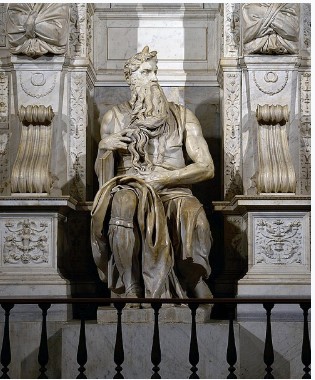
PROPHET OF LAW & DELIVERANCE
“Moses (Michelangelo) – Wikipedia.” Photograph, 2000s. https://en.wikipedia.org/wiki/Moses_(Michelangelo) (accessed October 4, 2025).
A marble statue of a seated bearded man with horns, muscular build, holding tablets under one arm and grasping his beard, set in an ornate architectural niche.
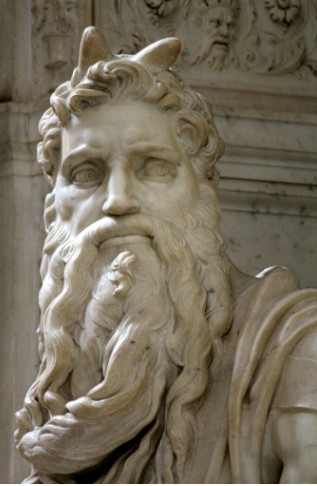
“The Horns of Moses – Biblical Archaeology Society.” Photograph, 2020s. https://www.biblicalarchaeology.org/daily/people-cultures-in-the-bible/people-in-the-bible/the-horns-of-moses/ (accessed October 4, 2025).
A detailed marble sculpture of Moses with horns on his head, long beard, and intense expression, seated and holding the Ten Commandments (inferred from similar iconic depictions).
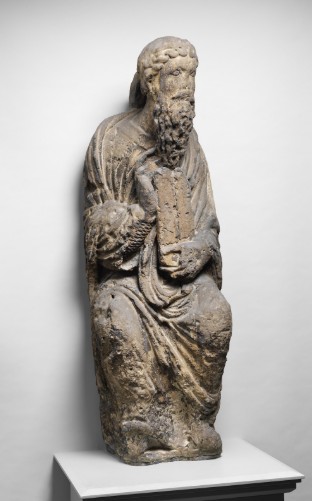
“Sculpture of Moses with Tablets of the Law – French – The Metropolitan Museum of Art.” Photograph, 2000s. https://www.metmuseum.org/art/collection/search/471850 (accessed October 4, 2025).
A weathered stone statue of a seated bearded man in robes, holding tablets in one hand and a staff or object in the other, displayed on a white pedestal against a plain background.