
HOMER
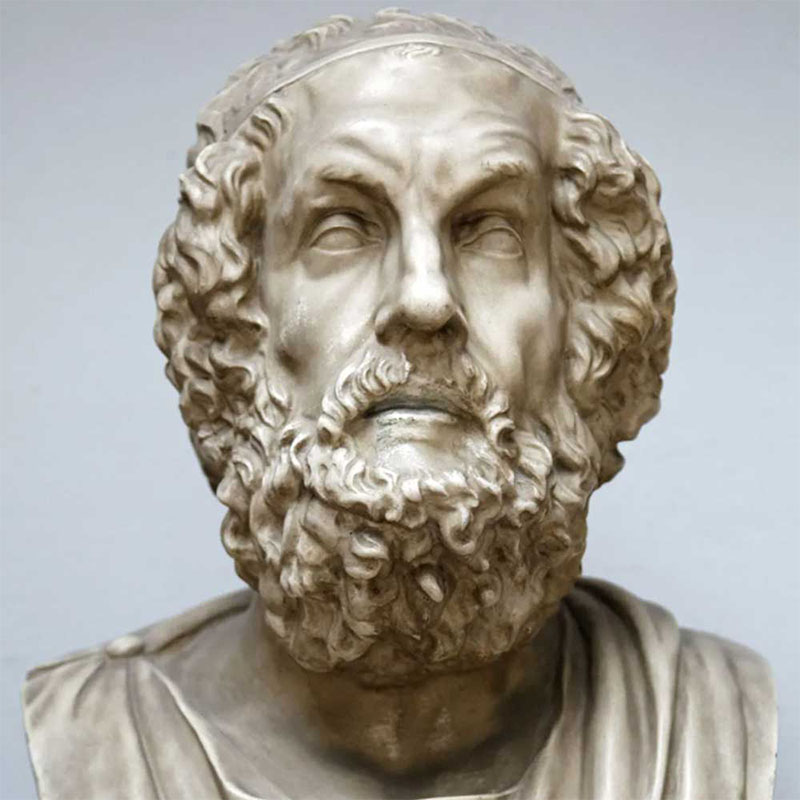
("Homer | Biography, Poems, & Facts | Britannica." Photograph, 2000s. https://www.britannica.com/biography/Homer-Greek-poet (accessed October 4, 2025).)
One poet, or two?
Ninth to eighth centuries B.C. · Ancient Greece
Homer is credited with authoring the two great epic poems of ancient Greece: the Iliad and the Odyssey. Little is known of Homer beyond the fact that his was the name attached in antiquity to the epics by the Greeks themselves.
Different in style and subject
- Credited with: The Iliad and the Odyssey, the two great epic poems of ancient Greece
- What we know: Little beyond the name the Greeks themselves attached to the epics
- Composed: Between the ninth and eighth centuries B.C., judging from evidence within the poems
- Authorship: Debated since the classical age
- In Greek schools: Children read and memorized verses from the poems
Why did the Greeks treat two poems as more than literature?
Hover or tap each idea to look closer
- Two Poems, Two StylesDifferences between the Iliad and the Odyssey in style and subject matter have led both Greeks of the classical age and modern scholars to suggest that the poems are the work of two men.
- Author or Inspiration?Some argue that Homer authored the first poem, the Iliad, but only inspired the second, the Odyssey.
- Youth and MaturityOthers suggest that the Odyssey is a product of Homer’s mature years, while the earlier Iliad reflects a youthful zeal for drama.
- Learned by HeartGreek children read and memorized verses from the poems as part of their schooling.
- Practical and Ethical InstructionFor the Greeks, the texts served as a source of both practical and ethical instruction.
Homer’s influence has been profound and long lasting.
Aside from their enduring popularity as literature, the Iliad and the Odyssey most likely shaped Western standards and ideas through their impact on classical Greek culture. The Greeks regarded the poems as more than just good literature: the texts both symbolized Greek unity and served as a source of practical and ethical instruction.
Secondary Literature (Scholarship):
Knox, Bernard. Introduction to Robert Fagles’ Iliad and Odyssey. Penguin Classics, 1990s.
Graziosi, Barbara. Homer. Oxford University Press, 2016.
Nagy, Gregory. The Best of the Achaeans. Johns Hopkins University Press, 1999.
Schein, Seth. Reading the Odyssey. Princeton University Press, 1996.
Archival or Online Sources:
Perseus Digital Library: https://www.perseus.tufts.edu
Homer Multitext Project: https://www.homermultitext.org
Internet Classics Archive: http://classics.mit.edu
Loeb Classical Library: https://www.loebclassics.com
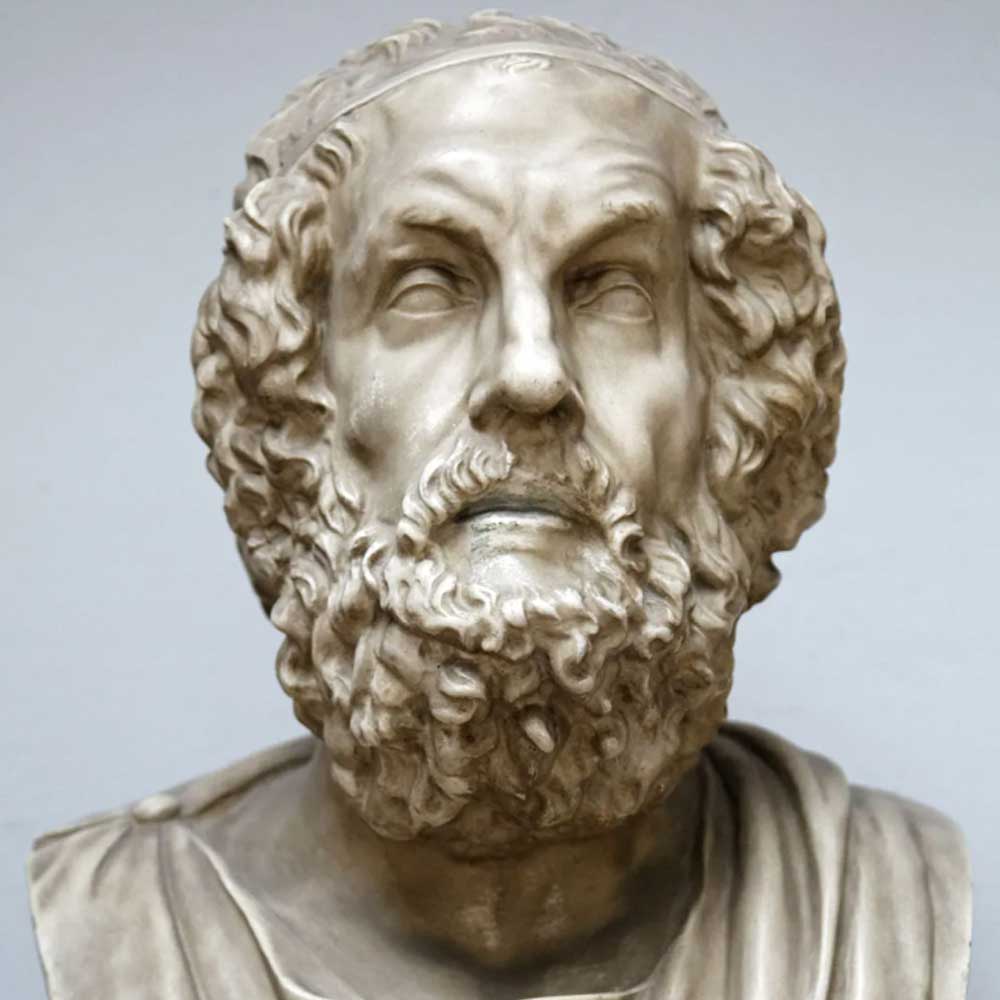
("Homer | Biography, Poems, & Facts | Britannica." Photograph, 2000s. https://www.britannica.com/biography/Homer-Greek-poet (accessed October 4, 2025).)
A marble bust of a bearded man with wavy hair and a stern gaze, draped in a toga, displayed on a pedestal against a gray background.
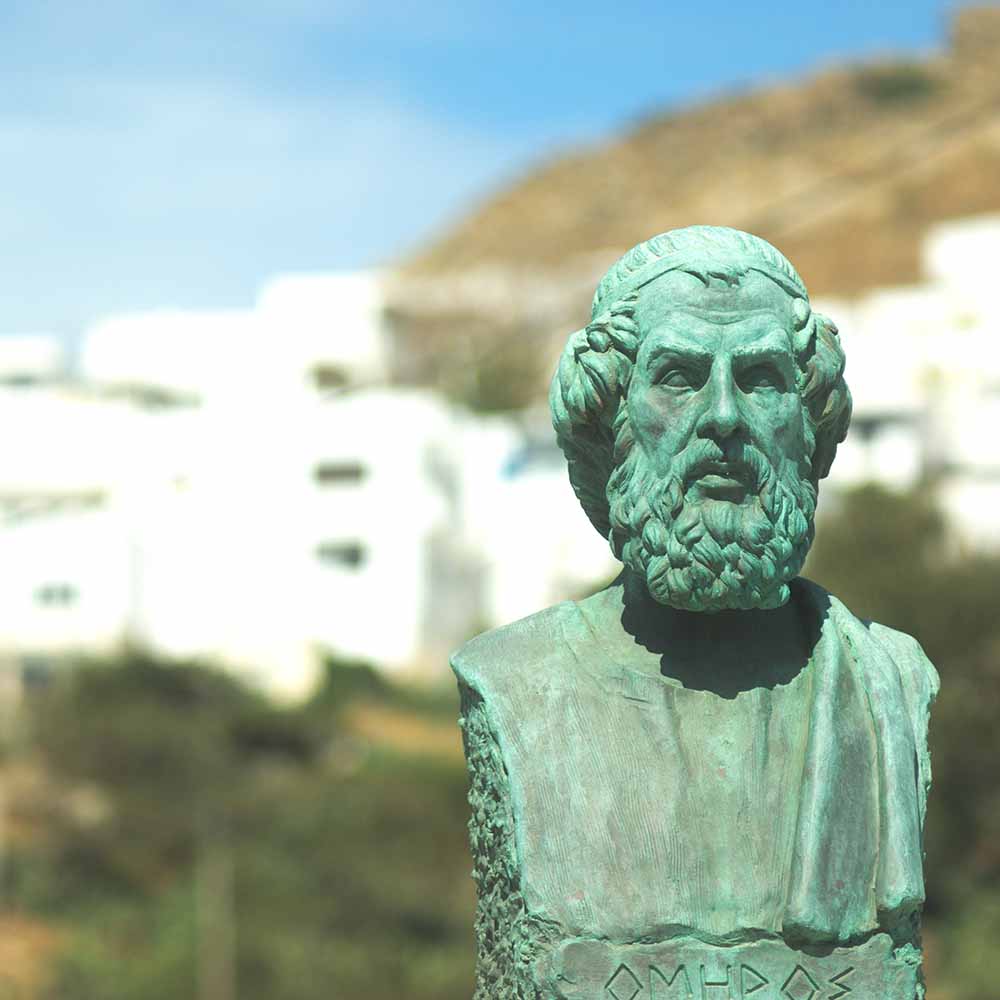
(The Greek holiday island of Ios. The harbor. A bust of Homer, the author of the Iliad and the Odyssey. Legend has it he is buried on this island.)
He is believed to have lived during the 8th or 7th century BCE, possibly in Ionia (modern-day western Turkey). The details of Homer’s birth and life are unclear, both by contemporary and scholastic sources.
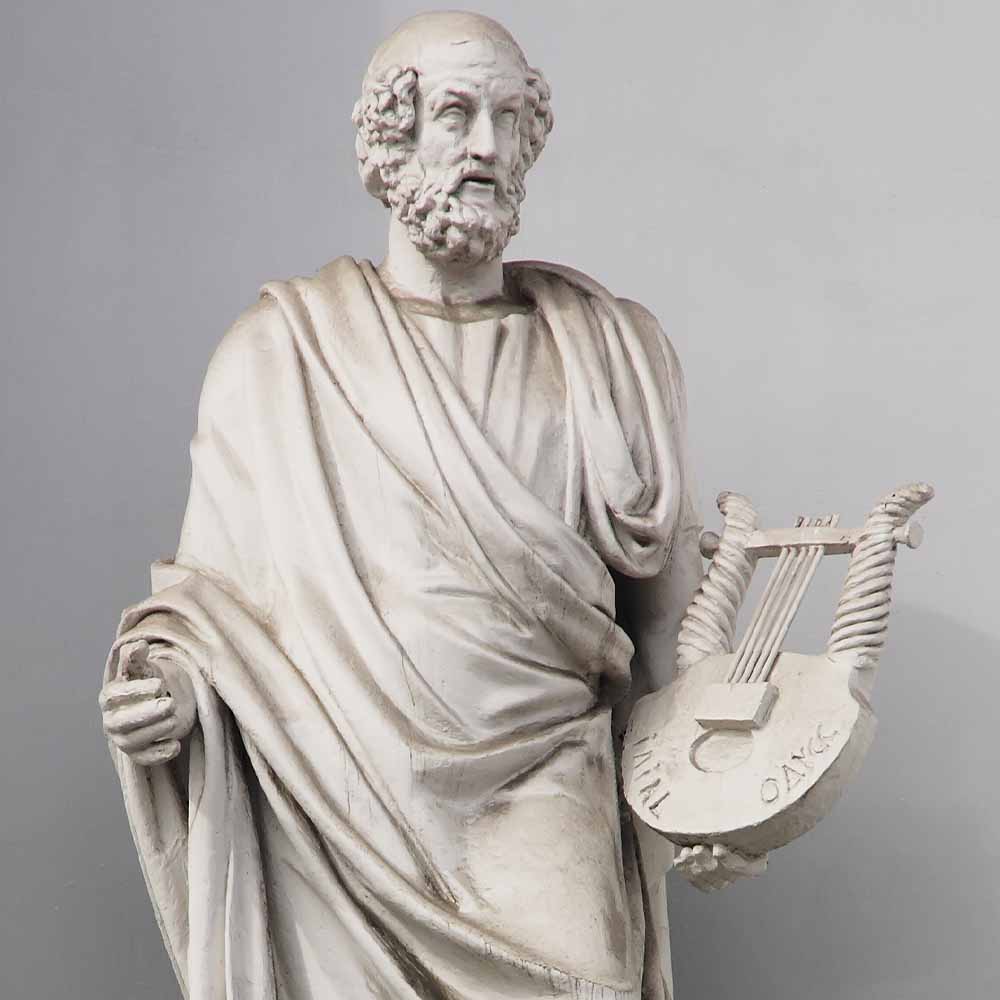
(Statue of Homer the Poet.)
Homer, the legendary Greek poet of the Iliad and Odyssey, crafted awe-inspiring epics around 1200 BCE, weaving heroic tales that ignite the soul. His timeless narratives have shaped Western culture for over three millennia, a majestic testament to the power of oral tradition.