
Gaius

GAIUS

Gaius
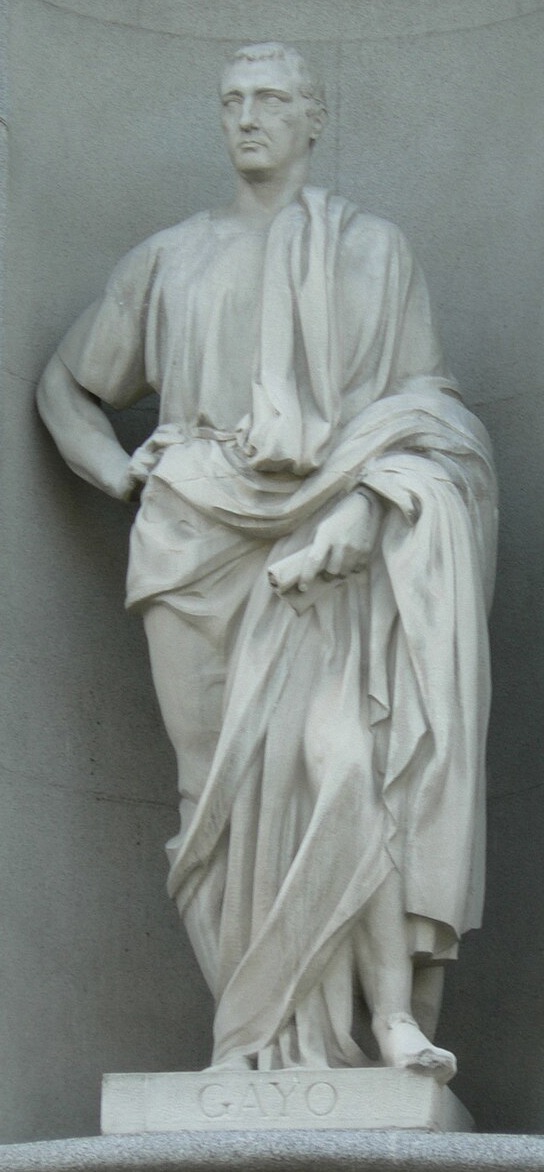
(Unknown. Bust of Gaius. Marble relief. 19th century. United States Capitol, Washington, D.C. Wikimedia Commons. https://commons.wikimedia.org/wiki/File:Flickr_-_USCapitol_-_Gaius_(c._110-180).jpg.)

Born: c. 110–180 CE, possibly Rome or Asia Minor

Died: Unknown (active in the 2nd century CE)

Notable

  • Codifier of Roman Law: Compiled the Institutes, a foundational textbook that systematized Roman jurisprudence into persons, things, and actions, influencing civil law traditions for centuries.
  • Praetor and Jurist Extraordinaire: As a leading Roman lawyer under emperors like Hadrian and Marcus Aurelius, he authored commentaries on praetorian edicts and provincial practices, bridging theory and legal practice.
  • Principle of Equity in Law: Emphasized good faith (bona fides) and natural reason in contracts and obligations, tempering rigid formalism with humane interpretation.

110 CE — Unknown

Biography

Gaius (full name unknown, fl. c. 160 CE) was a Roman jurist and legal educator whose Institutes became the foundational textbook of Roman law. Likely born in the eastern provinces (possibly Asia Minor), Gaius taught law in Rome during the Antonine era, outside the imperial bureaucracy. He systematized centuries of legal tradition into a clear, student-oriented framework, dividing law into persons, things, and actions. His work influenced the later Corpus Juris Civilis under Justinian and shaped European legal education for centuries. Gaius’s followers are not documented as a formal school, but his method—analytical, pragmatic, and accessible—dominated legal pedagogy.

Gaius’s Institutes has been interpreted by modern scholars as a proto-systematic and comparative approach to law, emphasizing institutional logic over casuistry. His plain style and avoidance of rhetoric contrasted with contemporary jurists like Ulpian or Papinian. Gaius’s framework stood apart from philosophical jurisprudence (e.g., Cicero) and administrative edicts, ultimately surviving through medieval glossators and the 19th-century Pandectist revival.


Bibliography & Major Works

Major Published Works:

Institutes (Institutiones)

Composed c. 161 CE.

Survives in 4 books, a systematic introduction to Roman private law.

Original language: Latin.

Other attributed works (fragmentary or lost):

Ad edictum provinciale (commentary on provincial edict, ~30 books)

Ad legem XII tabularum (on the Twelve Tables)

Res cottidianae (daily matters, possibly an early version of the Institutes)

Key Manuscripts and Editions:

Verona Palimpsest (Codex Veronensis, 5th century) – primary manuscript of the Institutes, discovered 1816.

Loeb Classical Library: The Institutes of Gaius (trans. de Zulueta, repr. 1946) – https://www.hup.harvard.edu/catalog.php?isbn=9780674993126

Seckel-Kuebler Edition: Gai Institutiones (Teubner, 1935) – standard critical text.

Digital Corpus: The Digest of Justinian (Latin/English, trans. Mommsen et al.) includes Gaius excerpts – https://droitromain.univ-grenoble-alpes.fr

Influences & Notable For

Notable For

Author of the Institutes: First systematic textbook of Roman law, used as a model for Justinian’s Institutes (533 CE).

Tripartite Division of Law: Persons, Things, Actions—still foundational in civil law systems.

Clarity and Pedagogy: Wrote for students, not practitioners; avoided rhetorical flourish.

Preservation of Archaic Law: Retained explanations of obsolete institutions (e.g., mancipatio, stipulatio).

Sources:

Schulz, Fritz. History of Roman Legal Science (Oxford, 1946)

Jolowicz, H.F. Historical Introduction to Roman Law (Cambridge, 1939)

Influences

Republican Jurisprudence: Built on the ius civile of the Twelve Tables and pontifical law.

Praetorian Edict: Incorporated magistrate-made law (ius honorarium).

Hellenistic Legal Education: Used Greek-style hypothetical cases and dialectical method.

Antonine Jurists: Contemporary with Pomponius, Africanus; predated Papinian and Ulpian.

Sources:

Stein, Peter. Roman Law in European History (Cambridge, 1999)

Tellegen-Couperus, Olga. A Short History of Roman Law (Routledge, 1993)

Famous quotes
  • “Ius civile est quod quisque populus ipse sibi constituit.” (“Civil law is what each people establishes for itself.”) – Gaius, Institutes 1.1
  • “Omne ius quo utimur vel ad personas pertinet vel ad res vel ad actiones.” (“All the law we use pertains either to persons, or to things, or to actions.”) – Gaius, Institutes 1.8
  • “Libertas est naturalis facultas eius quod cuique facere libet, nisi si quid vi aut iure prohibetur.” (“Freedom is the natural power of doing what one pleases, unless prevented by force or law.”) – Gaius, Institutes 1.53 (via Digest 1.5.4)
Legacy & Modern Significance

Historical Transmission: Lost in the West until 1816 rediscovery of the Verona palimpsest; preserved in Justinian’s Digest.

Medieval Revival: Glossators (12th c.) used Gaius to reconstruct Roman law; basis of the ius commune.

19th-Century Pandectism: German scholars (Savigny, Jhering) treated Gaius as a primary source for systematizing law.

Ongoing Influence: Tripartite scheme underlies modern civil codes (e.g., BGB, Code Napoléon).

Sources:

Zimmermann, Reinhard. The Law of Obligations (Oxford, 1996)

Gordley, James. The Jurists (Oxford, 2013)

Modern Moments & Impact on 21st Century

1816: Discovery of the Verona palimpsest by Niebuhr and Bluhme, revolutionizing Roman law studies (Goeschen Verlag announcement).

1946–1950: Francis de Zulueta’s bilingual edition of the Institutes (Oxford) became the standard English translation (repr. Loeb – https://www.hup.harvard.edu/catalog.php?isbn=9780674993126).

2007: Launch of the Amanuensis project (digitization of the Verona manuscript) – https://www.gaius-veronensis.it

Ongoing (2000s–Present): The Institutes are fully digitized with commentary on the Roman Law Library (Grenoble) – https://droitromain.univ-grenoble-alpes.fr

Ongoing (2010s–Present): Roman law and Gaius are core in civil law curricula at universities in Germany, Italy, France, and Latin America (e.g., Humboldt, Bologna, Paris II).

Ongoing (2000s–Present): The Oxford Classical Dictionary and Brill’s New Pauly maintain peer-reviewed entries on Gaius.

2020: Publication of Gaius: A Biography by Kaius Tuori (Routledge), first modern monograph on the jurist’s life and context – https://www.routledge.com/Gaius/Tuori/p/book/9781138480513

Ongoing (2020s): Gaius’s tripartite system is referenced in comparative law, legal theory, and AI-driven legal modeling (e.g., Stanford CodeX, EU civil code harmonization projects).

Suggested Reading and Resources

Secondary Literature (Scholarship)

Honoré, Tony. Gaius. Oxford University Press, 1962.

Schulz, Fritz. History of Roman Legal Science. Oxford, 1946 (repr. 2001).

de Zulueta, Francis. The Institutes of Gaius (2 vols.). Oxford, 1946–1953.

Stein, Peter. Roman Law in European History. Cambridge University Press, 1999 – https://www.cambridge.org/core/books/roman-law-in-european-history/9780521643726

Tuori, Kaius. Gaius: A Biography. Routledge, 2020 – https://www.routledge.com/Gaius/Tuori/p/book/9781138480513

Archival or Online Sources

Roman Law Library (Grenoble): Institutiones Gai (Latin/English) – https://droitromain.univ-grenoble-alpes.fr

Verona Palimpsest Digital Project – https://www.gaius-veronensis.it

Loeb Classical Library: The Institutes of Gaius https://www.hup.harvard.edu/catalog.php?isbn=9780674993126

Oxford Classical Dictionary: Gaius – https://oxfordre.com/classics

The Digest of Justinian (Mommsen-Krueger edition, via Heidelberg) – https://droitromain.univ-grenoble-alpes.fr