
EUCLID
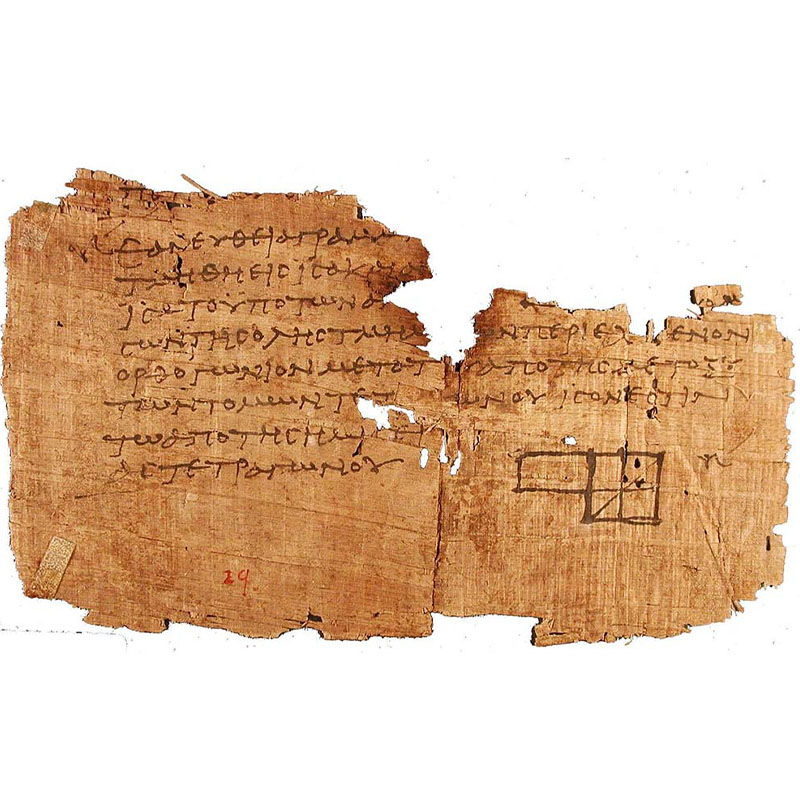
(Image: Euclid - https://openn.library.upenn.edu/Data/0016/html/e2748.html - Oxyrhynchus papyrus (P.Oxy. I 29) showing fragment of Euclid's Elements)
Who was the man behind one of the most influential works in the history of mathematics?
Active around 300 B.C. · Alexandria
Euclid was a Greek mathematician best known for authoring the Elements. While biographical details are sparse, he is believed to have taught and conducted research in Alexandria during the reign of Ptolemy I, drawing on earlier work by Eudoxus, Pythagoras, and Theaetetus.
Book I, Proposition 1: a triangle from a single line
- Known as: The Father of Geometry
- Birthplace: Possibly Tyre or Alexandria
- Education: Likely studied in Athens, in the Platonic tradition
- Career: Taught mathematics at the Mouseion (Museum), a major center of learning in Alexandria
- Best known for: The Elements, a standard textbook from antiquity through the 19th century
How can a handful of self-evident starting points build all of geometry?
Hover or tap each idea to look closer
- The Deductive MethodEuclid established the axiomatic method: begin from a few basic axioms and prove everything else step by step. It became the model for future scientific reasoning, and the rigor of mathematical proof has been traced to his work.
- Organizing What Came BeforeEuclid drew on the discoveries of earlier mathematicians such as Eudoxus, Pythagoras, and Theaetetus, organizing them into a single logical system.
- Pythagorean and Platonic RootsHe inherited from earlier Greek thinkers like Pythagoras and Plato the belief in order and harmony in the cosmos.
- Eudoxus and ProportionEudoxus of Cnidus contributed foundational work on proportions and magnitudes that Euclid used in the Elements.
- Hellenistic AlexandriaEuclid flourished as Alexandria rose as a center of intellectual life, drawing on a wealth of scholarship and patronage under Ptolemaic rule.
- No Royal RoadWhen King Ptolemy I reportedly asked for a shortcut to mathematical knowledge, Euclid is said to have replied:“There is no royal road to geometry.”
The Elements shaped mathematics, science, architecture, and philosophy across many cultures.
Medieval Islamic and Renaissance scholars drew on Euclid in architecture, geometry, and optics, and his axiomatic method influenced thinkers like Descartes, Newton, and Spinoza. The Elements is often said to have been printed more than 1,000 times after the invention of the printing press, second only to the Bible. In the 19th century, non-Euclidean geometries challenged some of his assumptions but also confirmed the enduring power of his logical framework.
Where to read more about Euclid and the Elements.
- 1956The Thirteen Books of Euclid’s ElementsHeath, Thomas L. · Dover Publications · originally published 1908
- 1981Philosophy of Mathematics and Deductive Structure in Euclid’s ElementsMueller, Ian · MIT Press
- 1999The Mathematics of Plato’s Academy: A New ReconstructionFowler, David · Oxford University Press
- Euclid’s Elements, English Translation (David Joyce)An online edition with interactive diagrams, hosted by Clark University.mathcs.clarku.edu
- Perseus Digital LibraryGreek texts and translations.perseus.tufts.edu
- Project Gutenberg: The First Six Books of the Elements of EuclidA free edition by John Casey.gutenberg.org
- MacTutor History of Mathematics: EuclidA biography from the University of St Andrews.mathshistory.st-andrews.ac.uk
Father of Economics
(Image: Stock Adobe)
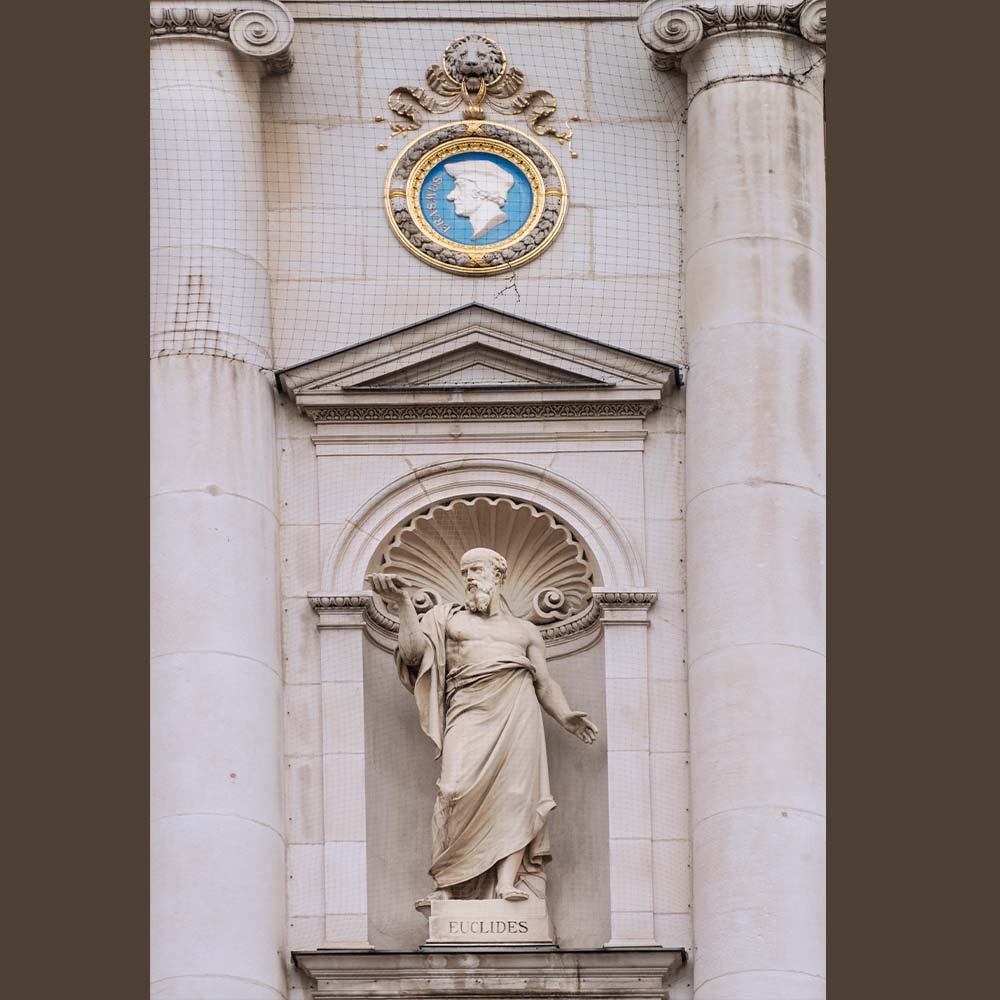
Euclids statue, The Mathematician, in old building's facade in Vienna, Austria, 2020
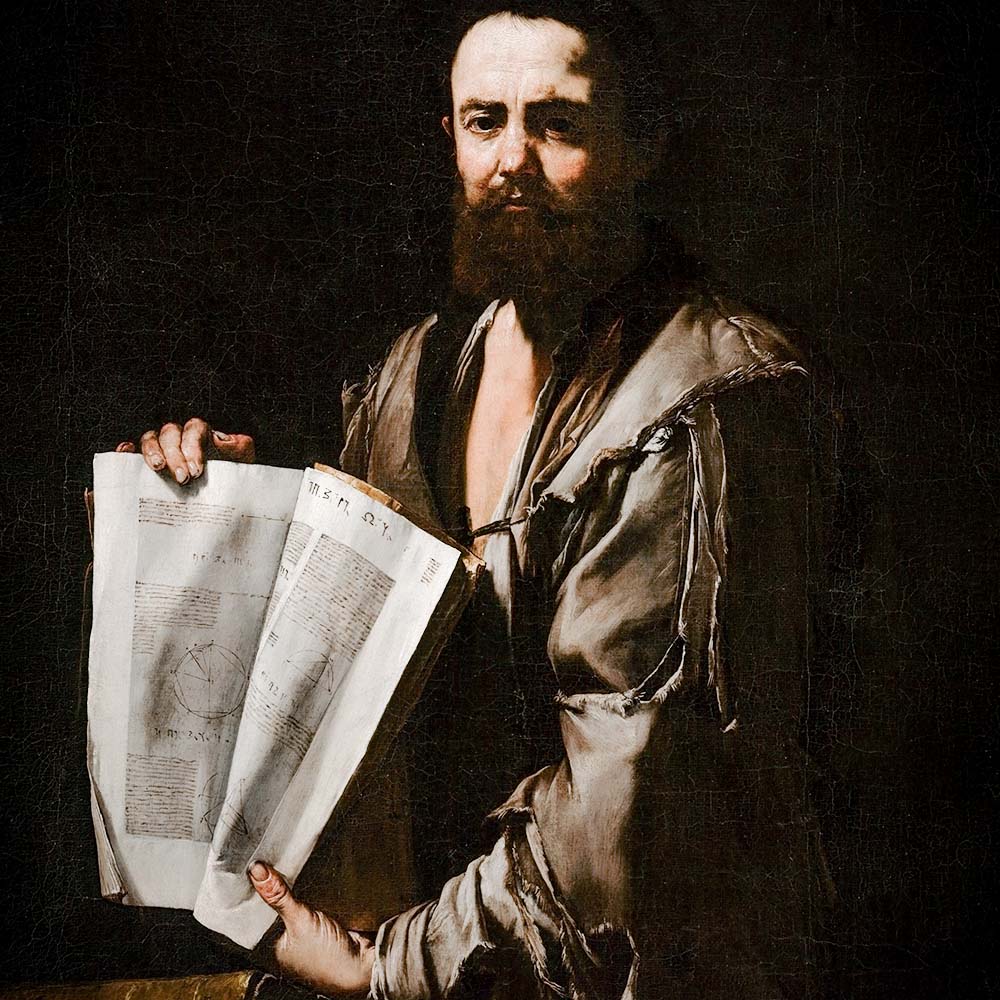
(Image: Jusepe de Ribera - Euclid - 2001.26 - J. Paul Getty Museum)
Euclid Painting by Jusepe de Ribera
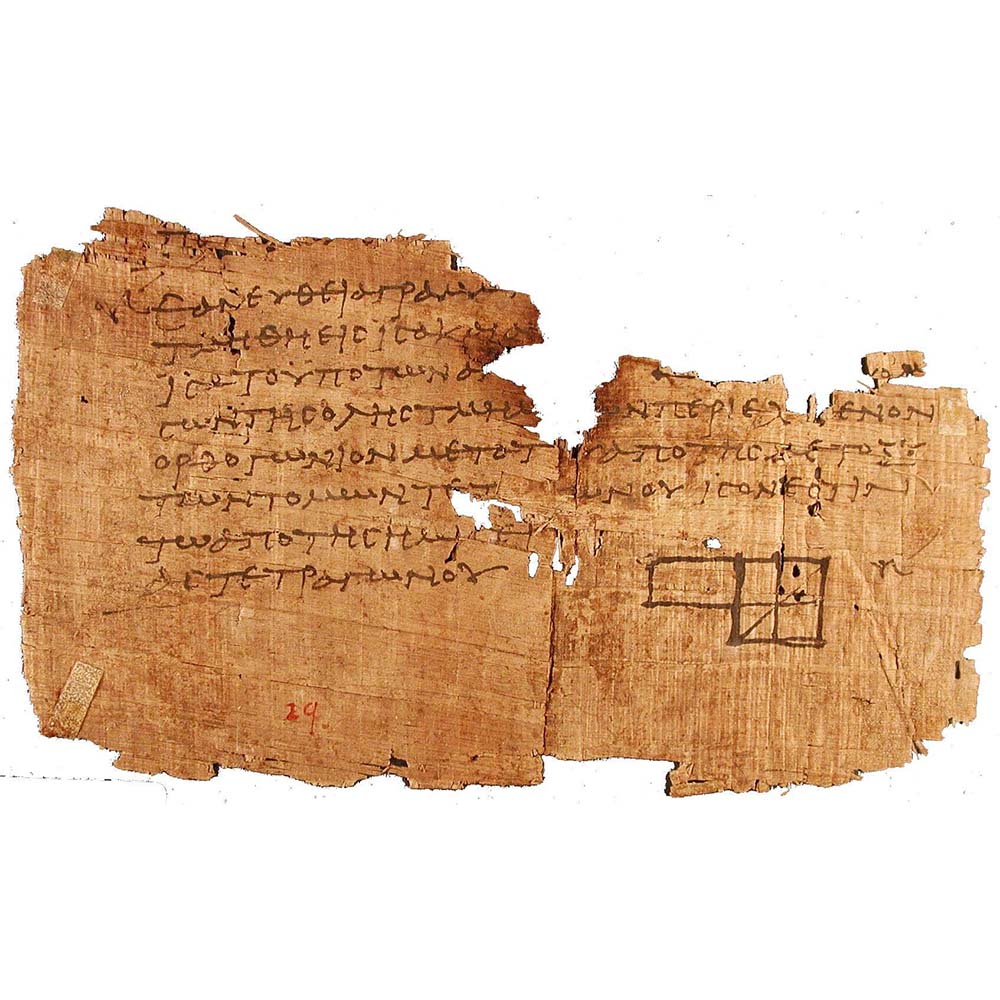
Papyrus Fragment of Euclid's Elements
(Image: Euclid - https://openn.library.upenn.edu/Data/0016/html/e2748.html - Oxyrhynchus papyrus (P.Oxy. I 29) showing fragment of Euclid's Elements)
A papyrus fragment of Euclid's Elements dated to c. 75–125 AD. Found at Oxyrhynchus, the diagram accompanies Book II, Proposition 5