
CONFUCIUS
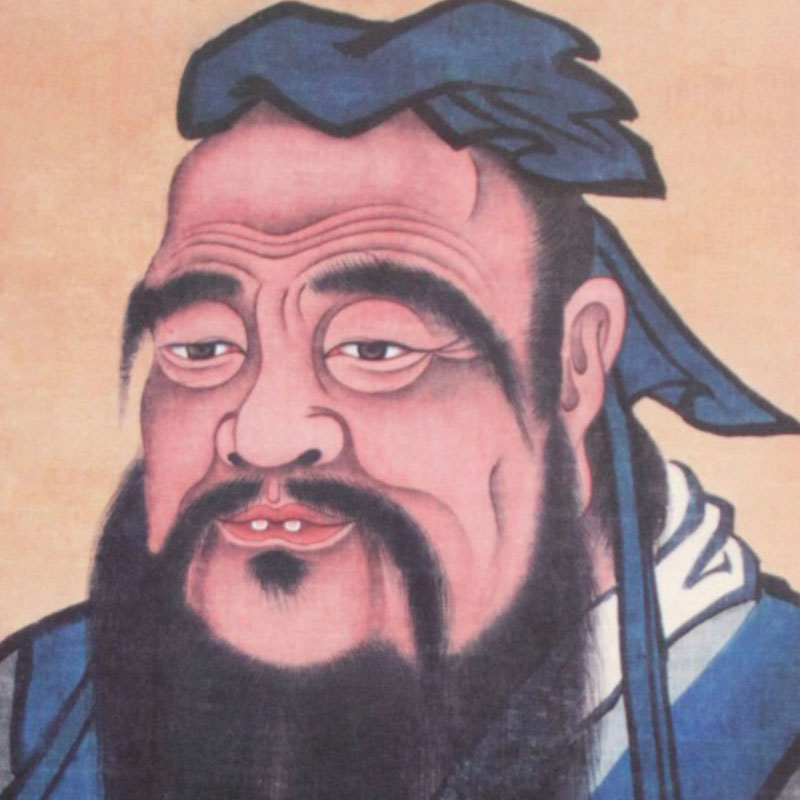
https://commons.wikimedia.org/wiki/File:Cropped_version_of_Confucius_Portrait,_Kongzi_(Confucius)_Family_Mansion,_Qufu_(13044335945).jpg
How did a self-taught son of a poor family become China’s greatest teacher?
551–479 B.C. · The state of Lu
Confucius is China’s most famous teacher, philosopher and political theorist. Legend and history are hard to separate in his story, but he likely came from a noble but impoverished family. Through dedicated self-education he became the most learned man of his day.
A following built through learning
- Name: K’ung Ch’iu; Confucius is the Latin form of K’ung Fu-tzu, “Master K’ung”
- Born: 551 B.C., in the state of Lu
- Died: 479 B.C., in Lu
- Family: Likely noble but impoverished
- Following: Three thousand students and seventy-two close disciples
- Classics: Said to have preserved and edited many early classics of Chinese literature
Can a ruler govern by example instead of by force?
Hover or tap each idea to follow Confucius’s answer
- Restoring the Old OrderLiving in the violent era before China’s unification under the Ch’in in 221 B.C., Confucius sought an intellectual basis for stable political and social order. His answer was to retrieve the old rituals and values that had kept the old feudal order stable, drawing on the legends of the ancient sage kings, especially the Duke of Chou, who ruled with wisdom and virtue rather than force.
- The Goodness of the HeartAt the core of his teaching is a firm belief in the basic goodness of the human heart. Every person’s goal should be to cultivate that goodness and achieve jen, which might be translated as “virtue.”
- Ritual and the Inner HeartJen is reached by careful attention to the customs and rituals of civilized life (li) and by listening to one’s true nature or inner heart (chung), which embraces reciprocity, righteousness and filial piety.
- Educated LeadersA vanguard of properly educated noblemen was crucial, and Confucius spent much of his life teaching them. Political and social stability, he taught, comes through virtue, wisdom and ritual in government.
- Moral Force, Not PunishmentInstructing rulers in the virtues of self-restraint became the main Chinese answer to the ancient problem of controlling the abuse of power.“Govern the people by regulations, keep order among them by chastisements, and they will flee from you, and lose all self-respect. Govern them by moral force, keep order by ritual and they will keep their self-respect and come to you of their own accord.” (Analects II.3, trans. Arthur Waley)
The most enduring legacy of Confucius’s teachings is the Analects, compiled by his disciples after his death.
Although his own time remained full of strife, his teachings came to dominate Chinese thought and were made official orthodoxy under the Han dynasty (206 B.C.–A.D. 220). Numerous schools of Confucianism arose and endured, losing their official status in China only in 1911.
Where to read more about Confucius and the Analects.
- 1985The World of Thought in Ancient ChinaSchwartz, Benjamin I. · Harvard University Press
- 2000An Introduction to ConfucianismYao, Xinzhong · Cambridge University Press
- 2002Confucius and the Analects: New EssaysVan Norden, Bryan W., ed. · Oxford University Press
- 2003Confucius Analects: With Selections from Traditional CommentariesSlingerland, Edward, trans. · Hackett Publishing
- 2007The Four Books: The Basic Teachings of the Later Confucian TraditionGardner, Daniel K. · Hackett Publishing
- The Analects of ConfuciusJames Legge’s translation, free from Project Gutenberg.gutenberg.org
- Chinese Text Project: The AnalectsThe original Chinese text alongside an English translation, with the other Confucian classics.ctext.org
- Stanford Encyclopedia of Philosophy: ConfuciusA scholarly entry by Mark Csikszentmihalyi on his life, teachings and legacy.plato.stanford.edu
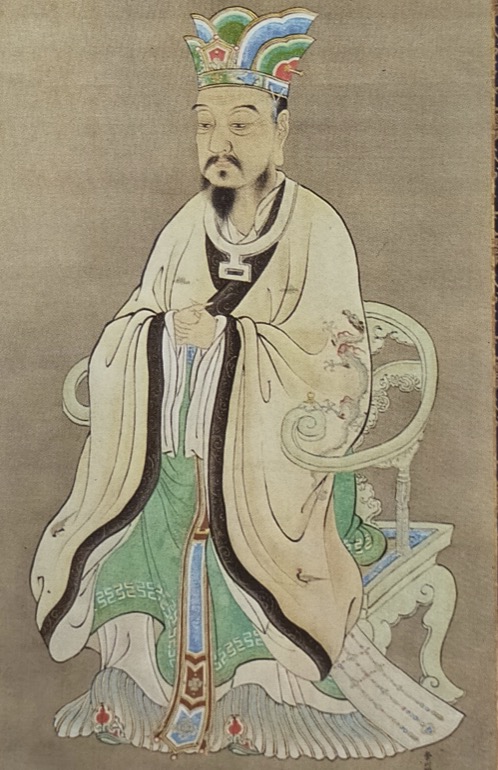
(Kano Michinobu. "Portrait of Confucius." Wikimedia Commons. 18th century. Accessed October 5, 2025. https://commons.wikimedia.org/wiki/File:Portrait_of_Confucius_by_Michinobu_Kano.jpg.)
Edo-period Japanese painting by Kano Michinobu, rendering Confucius with a wise, serene expression and flowing beard.
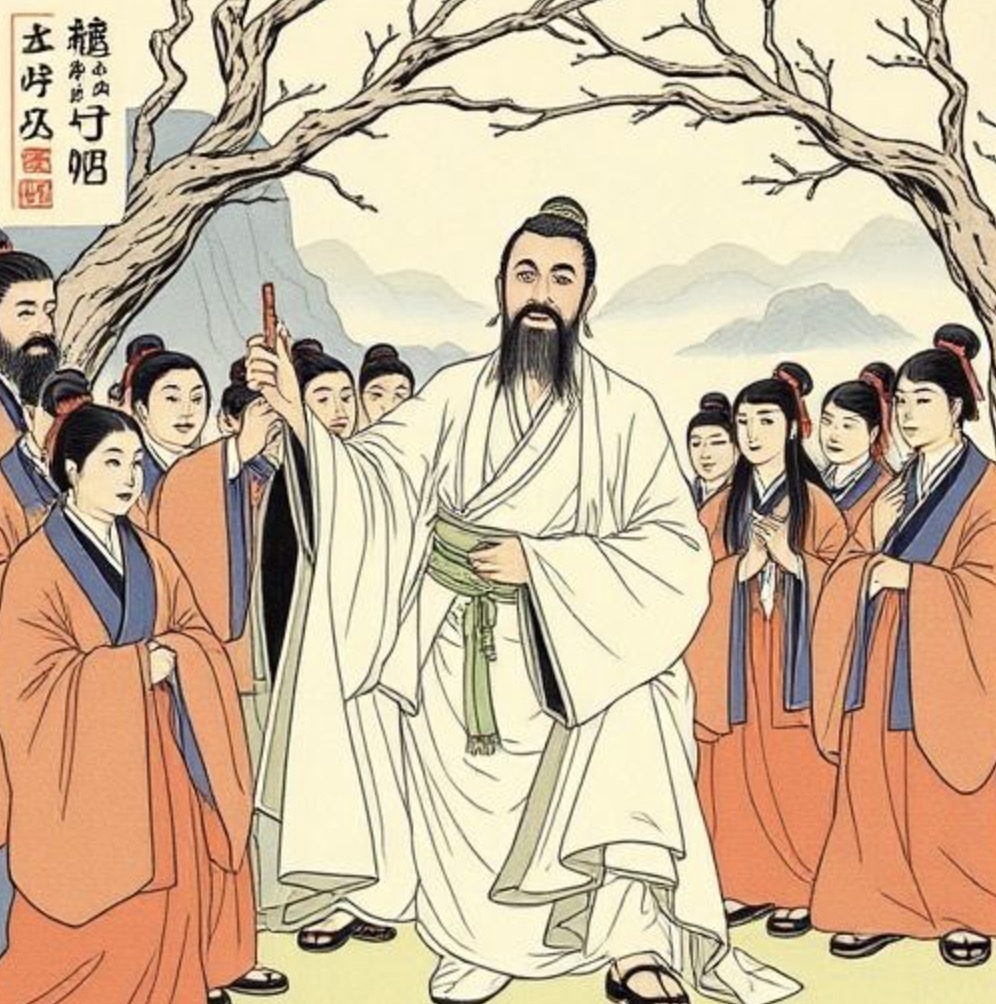
(AI-generated image)
Confucius' teachings on ren (benevolence) and the Five Relationships transformed East Asian society, fostering a timeless legacy of moral cultivation and harmonious governance.
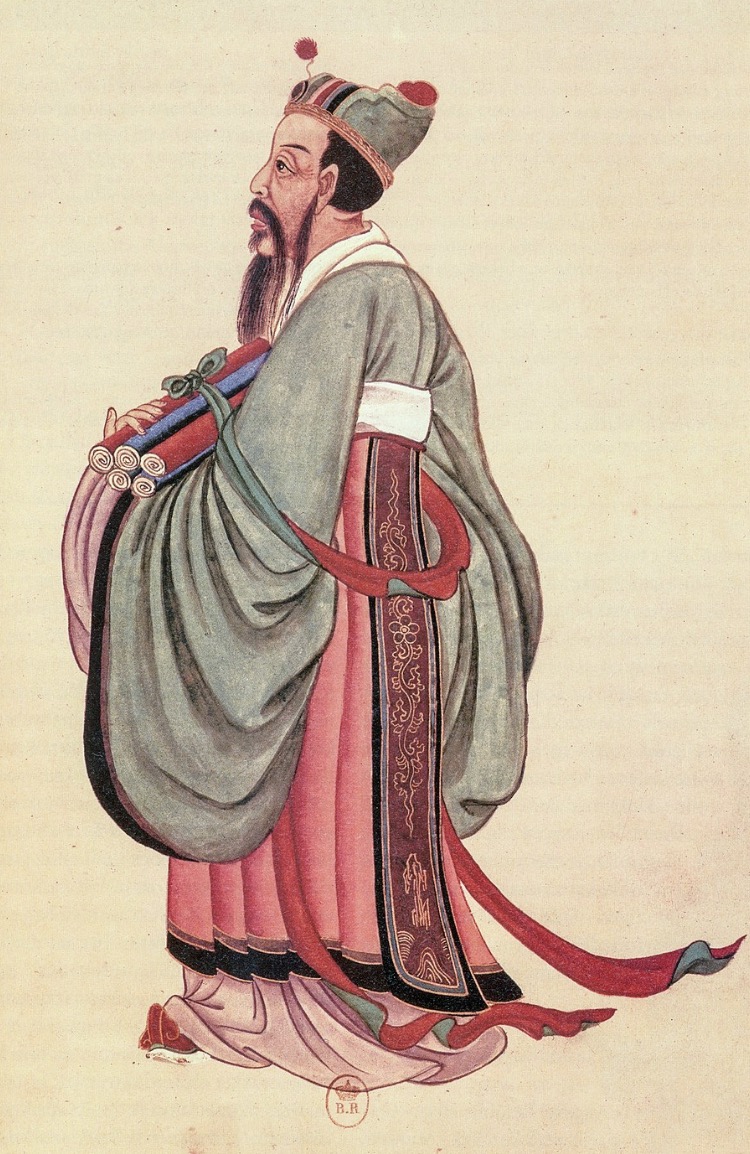
("Portrait of Konfucius, 18th Century." Wikimedia Commons. 18th century. Accessed October 5, 2025. https://commons.wikimedia.org/wiki/File:Portrait_of_Konfucius,_18th_century.jpg.)
An 18th-century Chinese ink portrait of Confucius in scholarly robes, housed in a traditional hanging scroll format.