Pierre F. Goodrich (1894–1973)
Pierre F. Goodrich, an Indianapolis businessman and lawyer, founded Liberty Fund, Inc. in 1960. Upon his death in 1973, Mr. Goodrich left a considerable portion of his estate to the foundation for the purpose of exploring the many dimensions of liberty. In 1996, Mr. Goodrich’s widow, Enid, passed away, leaving approximately one-half of her sizeable estate to Liberty Fund. Today, it is one of the largest private educational operating foundations in the country.
The earliest influences in Pierre Goodrich’s life were his family and community. Born in 1894 in the small East Central Indiana town of Winchester, he enjoyed success in local schools and graduated Phi Beta Kappa from Wabash College in 1916 and from Harvard Law School in 1920. From there, he returned to Indiana to begin the practice of law and to become, eventually, head of the Goodrich family’s financial empire begun by his father, James P. Goodrich, and his four uncles: Percy, John, Edward, and William.
The five Goodrich brothers established large ownership interests in utility companies, coal companies, telephone companies, railroads, banks, newspapers, securities, and other burgeoning industries in the early twentieth century. In addition, Mr. Goodrich’s father, James Goodrich, served for ten years as Chairman of the Indiana Republican Party (1901–1910) and as Indiana’s 29th Governor from 1917 to 1921.
Despite his father’s success in public service, Pierre Goodrich eschewed a life in politics, favoring business and ideas instead. By the mid-1940s, he was Chairman of the board of the Ayrshire Collieries Corporation, one of the largest coal companies in the country, President of the Indiana Telephone Corporation (then the fourteenth largest independent U.S. telephone company), and Vice President of City Securities and Central Newspapers, a large securities company and newspaper chain, respectively. He was also the President of the bank his father and uncles established in 1901, known as Peoples Loan and Trust Company. During his life he served on the board of directors of thirteen different companies.
During his decades of experience in owning and managing businesses, Pierre Goodrich believed that he had learned some valuable lessons about the importance of free enterprise, private property, limited government, and the role of the citizen in society. These early lessons were bolstered by serious study that he began in his forties of several of the most important legal, philosophical, moral, and ethical scholars of the past few thousand years.
His renewed interest in ideas caused him to read broadly from the writings of the Greeks, Romans, Asian thinkers, and more recent writers such as John Locke, Thomas Hobbes, David Hume, Adam Smith, John Stuart Mill, the French philosophers Montesquieu and Voltaire, and others. At the invitation of the University of Chicago President Robert Maynard Hutchins and philosopher Mortimer Adler, Goodrich joined the board of directors of the Great Books Foundation in 1947. That was the year that Goodrich also established the “Indiana Temporary Committee on the Great Books.” With the cooperation of leaders of several Indiana colleges and universities, Goodrich oversaw and often personally funded the establishment of more than thirty Great Books chapters in Indiana cities and towns as well as leadership training conferences.
Goodrich’s intellectual interests were broadened when he became a trustee of the Foundation for Economic Education (FEE) in 1952, a member of the Mont Pelerin Society in 1953, and an important trustee of his alma mater, Wabash College, replacing his father on the board in 1940 when his father passed away. Other organizations, among others, that Mr. Goodrich devoted his time and resources to included the China Institute of America, the Intercollegiate Studies Institute (ISI), and the Institute for Humane Studies (IHS).
Through his association with these organizations, he became exposed to the ideas and became acquainted with some of the great scholars and thinkers of the twentieth century, including Leonard Read, Friedrich Hayek, Ludwig von Mises, Wilhelm Röpke, Milton Friedman, George Stigler, William F. Buckley, West German Chancellor Ludwig Erhard, Karl Popper, Russell Kirk, and F.A. “Baldy” Harper.
From his readings and interactions with such thinkers, Mr. Goodrich observed that human beings are far from perfect and have only a partial understanding of their own nature. Institutions, in turn, are fraught with imperfections. He was particularly concerned that intellectual hubris leads to pretensions of certainty about the nature of the world and to preposterous and dangerous “solutions.” This abuse of reason leads to restrictive institutional arrangements that concentrate political and economic power. Such concentrations invariably erode liberty and moral values.
The responsible course of action in an imperfect world, Mr. Goodrich believed, consists of making choices that favor liberty from among the imperfect options available. A commitment to liberty in all its dimensions offers the best chance to fragment and decentralize power and to release individual, creative initiative. A free society can maintain and enhance individual liberty and excellence, a genuine concern for others, a framework for social order, and economic well-being.
Mr. Goodrich believed that education in a free society requires a dialogue centered around the great ideas of civilization. He saw learning as an ongoing process of discovery, not limited to traditional institutional settings or specific ages. Education is, in his view, the lifelong responsibility of each individual. Liberty Fund carries out this conviction by promoting the ideal of a society of free and responsible individuals through full and open discussion.
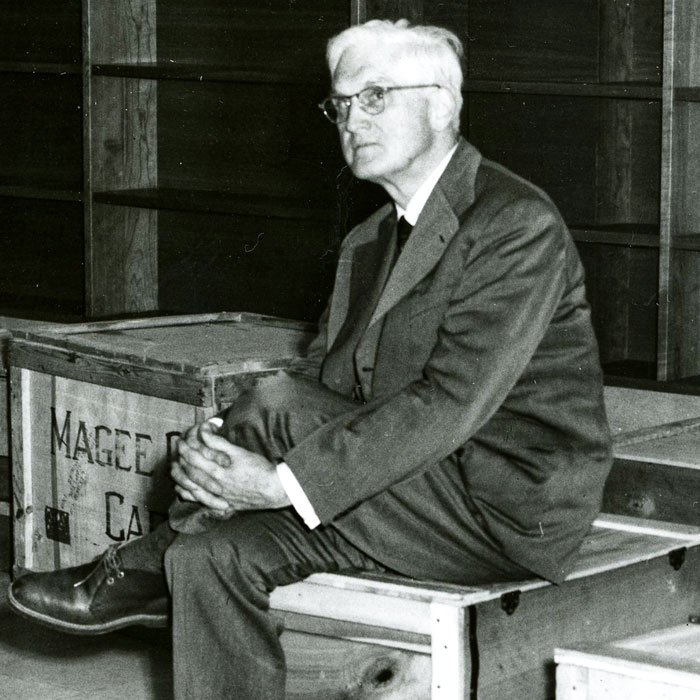
Born / Died
1894 – 1973
Born
Winchester, Indiana
BEST KNOWN FOR
Liberty Fund, Inc.; The Goodrich Seminar Room in Wabash’s main library, dedicated to liberty.
NOTABLE
In 1945, Pierre Goodrich established The Winchester Foundation in his hometown of Winchester, Indiana, and in 1965 the foundation he named “Thirty-Five Twenty.” Thirty-Five Twenty later became known as the “Pierre and Enid Goodrich Foundation” and has since merged with Liberty Fund. The Winchester Foundation continues to exist today.
These organizations were/are primarily grant-making in support of causes and institutions that Pierre Goodrich thought deserving of his philanthropy. In 1960, he founded Liberty Fund, a free-market foundation devoted to preserving and spreading classical liberal ideas. Today its headquarters are in Carmel, Indiana, a northern suburb of Indianapolis. In the latter 1950s, he wrote Liberty Fund Basic Memorandum, a 129-page booklet with instructions on how to run the organization.