
MENCIUS
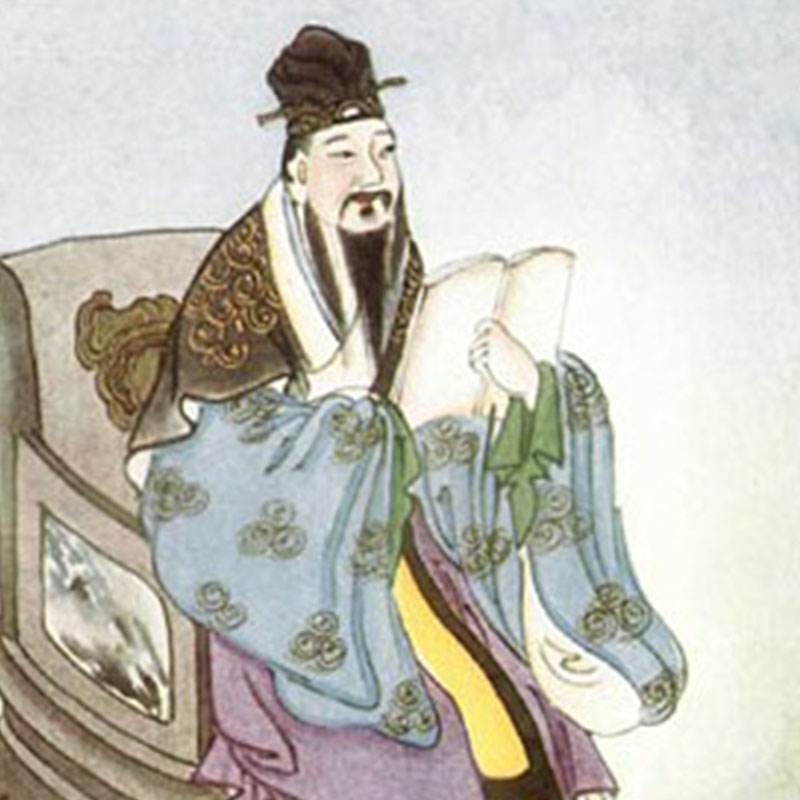
(“Mencius.” Ink on paper. Qing dynasty, circa 19th century. Unknown artist. Wikimedia Commons. https://commons.wikimedia.org/wiki/File:Mencius.jpg.)

Born: ca. 372 BCE, State of Zou, ancient China (modern-day Shandong Province)
Died: ca. 289 BCE, likely in the State of Song, ancient China
Notable
-
Innate Goodness: Argued that human nature is inherently good and inclined toward righteousness.
-
Confucian Influence: One of the most important Confucian thinkers after Confucius.
-
Four Sprouts: Identified compassion, shame, respect, and moral judgment as innate virtues.
-
Moral Governance: Linked benevolent rule to the Mandate of Heaven.
372–289 CE
Biography
Mencius, also known as Mengzi or Meng-tzu, was one of the influential Chinese Confucian philosophers who lived during the Warring States period. He is considered one of the most important Confucian thinkers after Confucius himself (often referred to as the Second Sage). Mencius was born in the state of Zou (now known as Shandong Province) in 371 BCE and is believed to have died around 289 BCE. Little is known about his early life, but he is said to have studied the teachings of Confucius himself, where he spent much of his time traveling to various states, counseling different rulers.
Mencius is best known for his work Mencius, a collection of conversations and dialogues with different rulers that expound his ethical and political philosophy. He is often credited with developing Confucian thought (i.e., Confucian Classic) and emphasizing that human nature is full of righteousness and innate goodness. Mencius believed that people are inherently good but can be influenced by their environment and upbringing. His ideas on the importance of moral cultivation and self-improvement have had a lasting impact on Chinese philosophy and ethics.
Despite facing criticism from other schools of thought during his time, Mencius’s teachings have continued to influence generations of scholars and thinkers in China and beyond. His emphasis on the cultivation of virtues and the role of government in fostering moral behavior remains relevant in contemporary discussions on ethics and governance.
Bibliography & Major Works
The primary source for Mencius’s teachings is the book named Mencius, which is a collection of his conversations and dialogues with different rulers compiled by his disciples. This text is considered one of the Four Books of Confucianism and is essential for understanding Mencius’s philosophical ideas or principles. In addition to the book, there are several other texts attributed to Mencius, which include commentaries on the Book of Documents and the Book of Odes.
Mencius’s teachings have been preserved in multiple ancient Chinese texts, such as the Records of the Grand Historian by Sima Qian and the Zhuangzi by Zhuang Zhou. These texts provide valuable insights into Mencius’s life, thought, and influence on Chinese philosophy. Scholars have studied these primary sources to gain a deeper understanding of Mencius’s ethical and political philosophy.
Influences & Notable For
Mencius is best known for his ethical and political philosophy, which emphasized that human nature is full of righteousness and innate goodness.
He is considered one of the most important Confucian thinkers after Confucius himself. Mencius’s ideas on the importance of benevolence, righteousness, and the role of government in promoting moral behavior have had a lasting impact on Chinese culture and beyond.
One of Mencius’s key contributions to Confucianism was his belief in the Four Sprouts of Goodness (i.e., compassion, shame, respect, and right and wrong).
He argued that these virtues are inherent in human nature and can be cultivated through self-reflection and moral education.
Mencius also advocated for the idea of the Mandate of Heaven, which suggests that rulers who govern with benevolence and righteousness will be supported by divine forces.
Famous quotes
“The great man is he who does not lose his child’s-heart.” – Mencius, Book IV, Part B, Chapter 12
“Human nature is good, just as water flows downward.” – Mencius, Book VI, Part A, Chapter 2
“To exhaust one’s mind is to understand one’s nature; to understand one’s nature is to understand Heaven.” – Mencius, Book VII, Part A, Chapter 1
“It is only after a man has refused to do certain things that he is capable of doing great things.” – Mencius, Book IV, Part B, Chapter 28
Major Works
Mencius: Mencius is primarily known for his work Mencius, which is a collection of dialogues and conversations with leaders that expound his ethical and political philosophy. The text is divided into seven books, each focusing on different aspects of Mencius’s teachings. In Mencius, he discusses topics such as the innate goodness of human nature, the importance of moral cultivation, the role of government in fostering virtue, and the concept of the Mandate of Heaven.
Book of Documents and the Book of Odes: These are texts attributed to Mencius, which include commentaries providing further insights into Mencius’s interpretation of Confucian classics and his views on morality and governance. These writings have been studied by scholars for centuries and continue to be a significant source of inspiration for those interested in Chinese philosophy and ethics.
Legacy & Modern Significance
Historical Significance: The legacy of Mencius in Chinese philosophy and culture is significant, as he is considered one of the most important Confucian thinkers in history. In contemporary China, Mencius is still revered as a moral exemplar and a symbol of Confucian values. His ideas shaped traditional Chinese philosophy, ethics, education, and the concept of just government.
Modern Significance: Mencius’s philosophy and teachings deeply shape Chinese, Korean, and Japanese political thought and ethics even today. His emphasis on the innate goodness of human nature and the importance of moral cultivation has had a lasting impact on Chinese ethical thought. Mencius’s ideas continue to be studied and debated by scholars around the world, influencing discussions on virtue ethics, political philosophy, and moral education.
Modern Moments & Impact on the 21st Century
In 2017, the University of Chicago Press published a new English translation of Mencius’s Mencius by Philip J. Ivanhoe, bringing his teachings to a wider audience in the 21st century.
Inspired by Mencius, China and South Korea have included Confucian moral education in school textbooks and national curricula since the early 2000s.
The International Society for Chinese Philosophy regularly organizes conferences and symposiums on Mencius’s philosophy, showcasing his enduring relevance in contemporary academic discourse.
In philosophy departments around the world—at universities like Oxford, Harvard, and Peking—Mencius is now studied alongside major Western philosophers. In recent years, there has been a growing body of books, journals, and academic discussions comparing Mencius’s ideas with Aristotle, Kant, and modern virtue ethicists.
Digital resources, such as online databases and e-books, have made Mencius’s works more accessible to a global audience, fostering continued interest in his ethical and political ideas.
Influences & Intellectual Context
Significant Intellectual and Cultural Influences: Mencius was heavily influenced by the teachings of Confucius and is often regarded as one of the most important Confucian thinkers in Chinese philosophy. He built upon the ethical and political ideas of Confucius, and his philosophy also drew on the works of earlier Confucian scholars, such as Zengzi and Yan Hui, who were disciples of Confucius.
Contributions to Fields or Disciplines: In addition to Confucianism, Mencius engaged in competing Warring States philosophies by debating with scholars from schools of thought such as Mozi and Xunzi, to defend his views on morality and governance. Mencius’s interactions with scholars of diverse philosophical backgrounds contributed to the development of his own ethical and political theories.
Suggested Reading & Resources
Ivanhoe, Philip J. “Mencius.” Stanford Encyclopedia of Philosophy.
https://plato.stanford.edu/entries/mencius/“International Society for Chinese Philosophy.”
https://chinese-philosophy.org/
University of Chicago Press. “New Books in East Asian Studies.”
https://www.press.uchicago.edu/ucp/books/series/NEAS.html
Irene Bloom, ed., Mencius. New York: Columbia University Press, 2009.
DEFENDER OF HUMAN GOODNESS
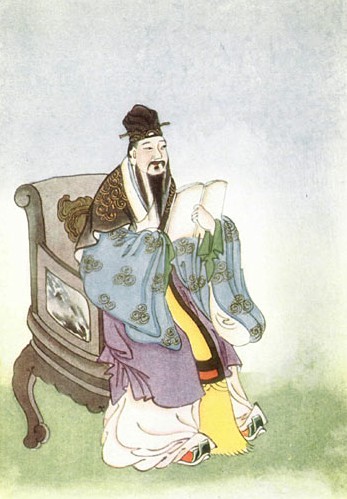
(“Mencius.” Ink on paper. Qing dynasty, circa 19th century. Unknown artist. Wikimedia Commons. https://commons.wikimedia.org/wiki/File:Mencius.jpg.)
A traditional Chinese portrait of Mencius, the Confucian philosopher, rendered in ink with a serene face and scholar’s robe, symbolizing moral and ethical teachings.
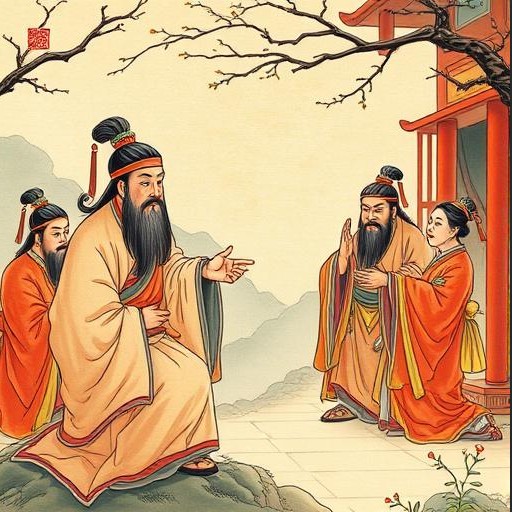
(Mencius, AI generated)
A traditional Chinese depiction of Mencius, the Confucian philosopher, shown teaching his disciples in a serene outdoor setting. Dressed in flowing scholar’s robes, Mencius gestures thoughtfully as his students listen attentively beneath a blossoming tree and beside a red pavilion. The artwork symbolizes wisdom, moral dialogue, and the transmission of ethical teachings central to Confucian philosophy.
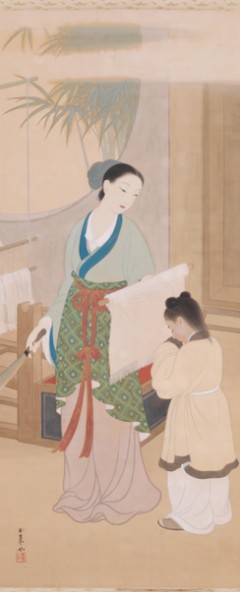
(Kurihara, Gyokuyō. “Mother’s Love (Mencius’ Mother Cutting the Loom).” Woodblock print. 1921. Ink and color on paper. Library of Congress, Washington, DC. Wikimedia Commons. https://commons.wikimedia.org/wiki/File:Kurihara_Gyokuyo_-_Mother%E2%80%99s_Love_(Mencius%E2%80%99_Mother_Cutting_the_Loom).png.)
.png)
A 1921 woodblock print by Kurihara Gyokuyō titled “Mother’s Love (Mencius’ Mother Cutting the Loom),” illustrating a key anecdote from Mencius’ life emphasizing diligence and family influence.