
CHAUCER
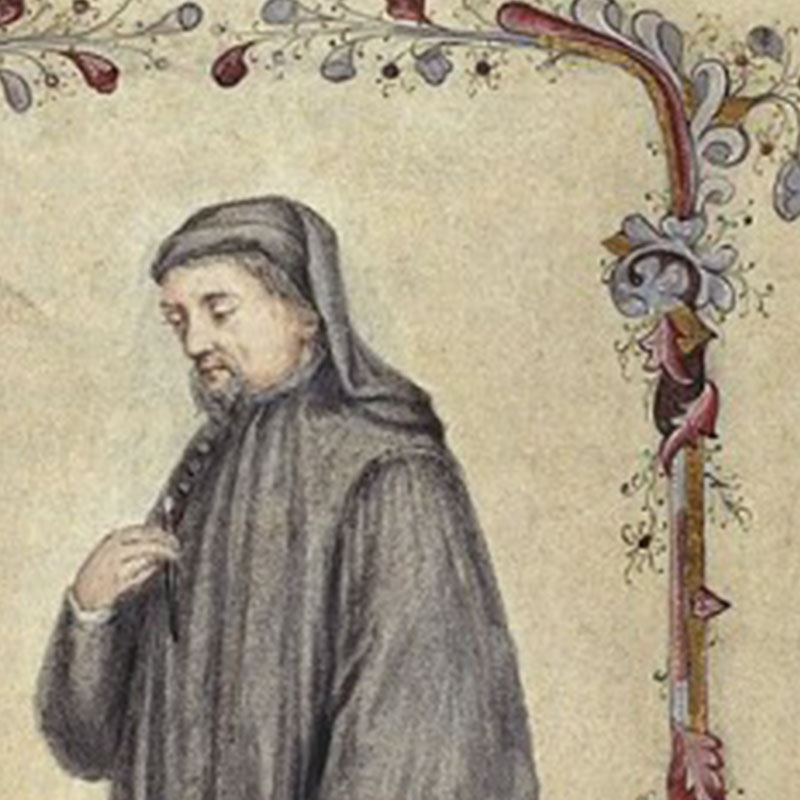
(Unknown illuminator. “Geoffrey Chaucer in Canterbury Tales Frontispiece.” Ink and color on vellum. 1478. British Library, London. Wikimedia Commons. https://commons.wikimedia.org/wiki/File:Geoffrey_Chaucer_-_Canterbury_Tales_(1478),_frontispiece_-_BL.jpg.)
,_frontispiece_-_BL.jpg)
Born: c.1343, London, England
Died: October 25, 1400, London, England
Notable
- “Father of English literature”: Pioneered the use of vernacular English for poetry at a time when literary works were predominantly written in French or Latin.
- Author of The Canterbury Tales: A foundational and enduring work in English literature, remarkable for its vivid characterizations and social commentary.
- Major developer of the Middle English poetic tradition: His innovative use of iambic pentameter and poetic forms transformed English verse and influenced generations.
- Accomplished courtier and diplomat: Merged governmental experience with literary ambition, infusing works with unique insights into English society.
1343-1400
Biography
Geoffrey Chaucer was born between 1340 and 1345 in London to John Chaucer, a prosperous wine merchant, and Agnes Copton. Through his father’s connections, he began his career serving as a page to Elizabeth, Countess of Ulster, and later held numerous important positions as a courtier, diplomat, civil servant, and collector of scrap metal. Chaucer was fluent in French, Italian, and Latin, traveled extensively on diplomatic missions—including trips to Italy, where he encountered works by Dante, Boccaccio, and Petrarch—and was awarded a life pension by King Edward III. He married Philippa de Roet, a lady-in-waiting to Queen Philippa. Chaucer’s extensive public service and worldliness profoundly informed his literary output, which established him as the preeminent English poet prior to Shakespeare. Chaucer was the first writer interred in what would become Poets’ Corner in Westminster Abbey.
Bibliography & Major Works
Major Published Works (with original editions/years):
The Book of the Duchess (c.1368–1372)
The House of Fame (c.1379–1380)
Anelida and Arcite (c.1378–1380)
Parlement of Foules (Parliament of Fowls) (c.1380–1382)
Troilus and Criseyde (c.1382–1386)
The Legend of Good Women (c.1386–1388)
The Canterbury Tales (c.1387–1400; unfinished)
A Treatise on the Astrolabe (c.1391)
Major Translations:
The Romaunt of the Rose (translation from French, possibly Chaucer, c.1360s–1370s)
Boece (translation of Boethius’ Consolation of Philosophy, c.1380s)
Key Manuscript/Archaeological Sources:
Ellesmere Manuscript (c.1410; The Canterbury Tales)
Hengwrt Manuscript (late 14th century; The Canterbury Tales)
Influences & Notable For
-
“Father of English literature”: Pioneered the use of vernacular English for poetry at a time when literary works were predominantly written in French or Latin.
-
Author of The Canterbury Tales: A foundational and enduring work in English literature, remarkable for its vivid characterizations and social commentary.
-
Major developer of the Middle English poetic tradition: His innovative use of iambic pentameter and poetic forms transformed English verse and influenced generations.
-
Accomplished courtier and diplomat: Merged governmental experience with literary ambition, infusing works with unique insights into English society.
Famous quotes
“The lyf so short, the craft so long to lerne.”
– Parlement of Foules (The Parliament of Birds)“If gold rusts, what then can iron do?”
– The Canterbury Tales, The Prologue (The Parson’s Tale)“And gladly would he learn, and gladly teach.”
– The Canterbury Tales, The General Prologue
Major Works
The Canterbury Tales (c.1387–1400)
General Prologue: Introduction of 29 pilgrims and their backgrounds.
Notable Tales: The Knight’s Tale (chivalric romance), The Miller’s Tale (fabliau), The Wife of Bath’s Tale (commentary on marriage and female agency), The Pardoner’s Tale (moral allegory), and over 20 other tales.
Structure: Frame narrative—pilgrims telling stories to pass the time on a journey to Canterbury Cathedral.
Troilus and Criseyde (c.1382–1386)
Five books: The tragic love story of Troilus and Criseyde during the Trojan War; explores fate, love, and betrayal.
The Book of the Duchess (c.1368–1372)
Dream-vision elegy commemorating Blanche of Lancaster.
The House of Fame (c.1379–1380)
Dream vision examining fame and its arbitrariness.
A Treatise on the Astrolabe (c.1391)
Technical manual introducing scientific concepts to his son Lewis.
Legacy & Modern Significance
Chaucer’s works have shaped the English literary tradition profoundly. The Canterbury Tales is a touchstone for later English literature, influencing figures from Shakespeare to modern novelists—its themes of social satire, moral inquiry, and narrative diversity remain relevant.
The poetry helped to legitimize Middle English as a literary medium, not only changing literary history but also the English language itself.
Chaucer’s texts are core curriculum in secondary and higher education globally and remain a focus of scholarly reinterpretation—especially regarding gender, class, and religious critique.
The Wife of Bath, in particular, has become an enduring symbol of female agency, inspiring feminist literary criticism.
His works are regularly referenced and adapted in literature, theater, and popular culture, attesting to the lasting vitality of his legacy.
Modern Moments & Impact on the 21st Century
2000–Present: Annual Chaucer festivals and international conferences held by organizations such as the New Chaucer Society.
2009–Present: Ongoing digital scholarly editions of Chaucer’s works released by universities; The Canterbury Tales Project (University of Leicester, Harvard’s Chaucer website) has published digital editions, manuscript transcriptions, and open resources.
2010s–Present: Numerous online platforms, including the British Library, have released digital facsimiles of The Canterbury Tales and other works.
Ongoing: The Canterbury Tales is a required or recommended text in literature curricula at universities and secondary schools worldwide, as shown by published syllabi and reading lists.
2019–Present: Educational institutions launched new critical editions and organized themed events, exhibitions, and lecture series celebrating Chaucer’s contributions to English heritage.
Influences & Intellectual Context
Heavily influenced by Italian poets Dante Alighieri, Giovanni Boccaccio, and Petrarch, especially after diplomatic missions to Italy in the 1370s.
Built upon French courtly love poetry traditions, notably Guillaume de Lorris’s and Jean de Meun’s Roman de la Rose (which he partially translated).
Classical influences from writers like Ovid and Virgil permeate his use of myth and allegory.
Deeply engaged with the social, political, and religious structures of 14th-century England, reflecting the complexities of contemporary society in his satire and characterizations.
Suggested Reading & Resources
Secondary Literature (Scholarship):
Derek Pearsall, The Life of Geoffrey Chaucer: A Critical Biography (Blackwell, 1992)
Jill Mann, Chaucer and Medieval Estates Satire (Cambridge University Press, 1973)
Carolyn Dinshaw, Chaucer’s Sexual Poetics (University of Wisconsin Press, 1989)
Paul Strohm, Social Chaucer (Harvard University Press, 1989)
Seth Lerer, Chaucer and His Readers: Imagining the Author in Late-Medieval England (Princeton University Press, 1993)
Archival or Online Sources:
Harvard Chaucer Page: https://chaucer.fas.harvard.edu/
Open Access Canterbury Tales Project: https://opencanterburytales.dsl.lsu.edu/
British Library Digital Manuscripts (includes Ellesmere MS): https://www.bl.uk/collection-items/the-elesmere-chaucer
Chaucer Bibliography Online (University of Texas at San Antonio): https://chaucer.lib.utsa.edu/omeka/collections/show/8
FATHER OF ENGLISH LITERATURE
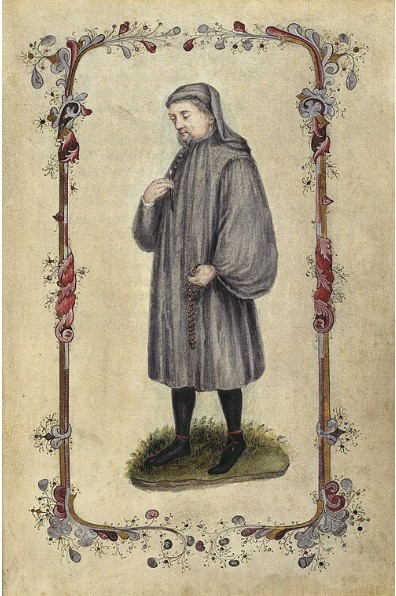
(Unknown illuminator. “Geoffrey Chaucer in Canterbury Tales Frontispiece.” Ink and color on vellum. 1478. British Library, London. Wikimedia Commons. https://commons.wikimedia.org/wiki/File:Geoffrey_Chaucer_-_Canterbury_Tales_(1478),_frontispiece_-_BL.jpg.)
A 16th-century frontispiece portrait from a manuscript of Chaucer’s Canterbury Tales, depicting the poet in pilgrim’s attire holding his book.
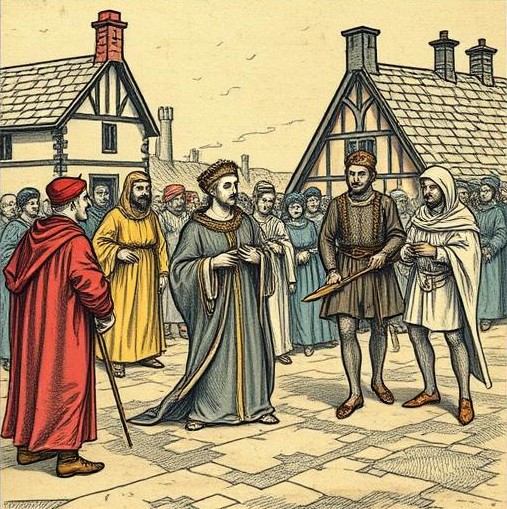
(Chaucer, AI generated)
A historical-style illustration showing Geoffrey Chaucer, often regarded as the Father of English literature, engaging in conversation with citizens and fellow writers in a medieval town square. Surrounded by people dressed in 14th-century attire, Chaucer stands at the center, wearing a scholarly robe and gesturing thoughtfully — a visual echo of his role as a storyteller and observer of human nature. The half-timbered houses and crowd convey the everyday life that inspired his Canterbury Tales, symbolizing his gift for capturing the voices, humor, and morality of ordinary people through poetic narrative.
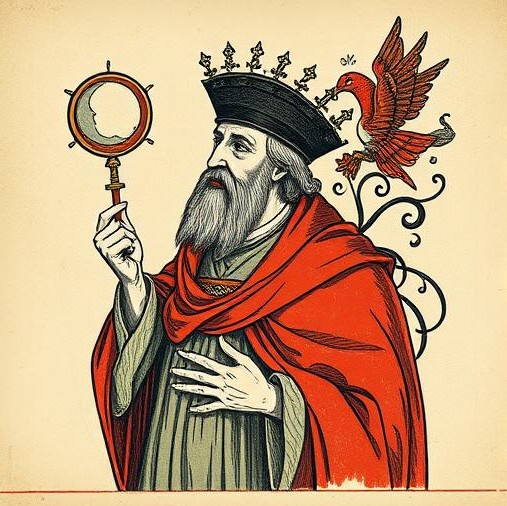
(Chaucer. AI generated)
A symbolic portrait of Geoffrey Chaucer, depicted as a wise medieval poet and observer of humanity. He is shown holding a mirror, representing reflection and truth, while a bird perched beside him symbolizes poetic inspiration and freedom of thought. The ornate crown of stars above his head suggests his enduring literary brilliance and influence as the Father of English poetry. Cloaked in red, Chaucer embodies both passion and intellect — a figure bridging the sacred and the earthly through the power of language and imagination.