

BOETHIUS
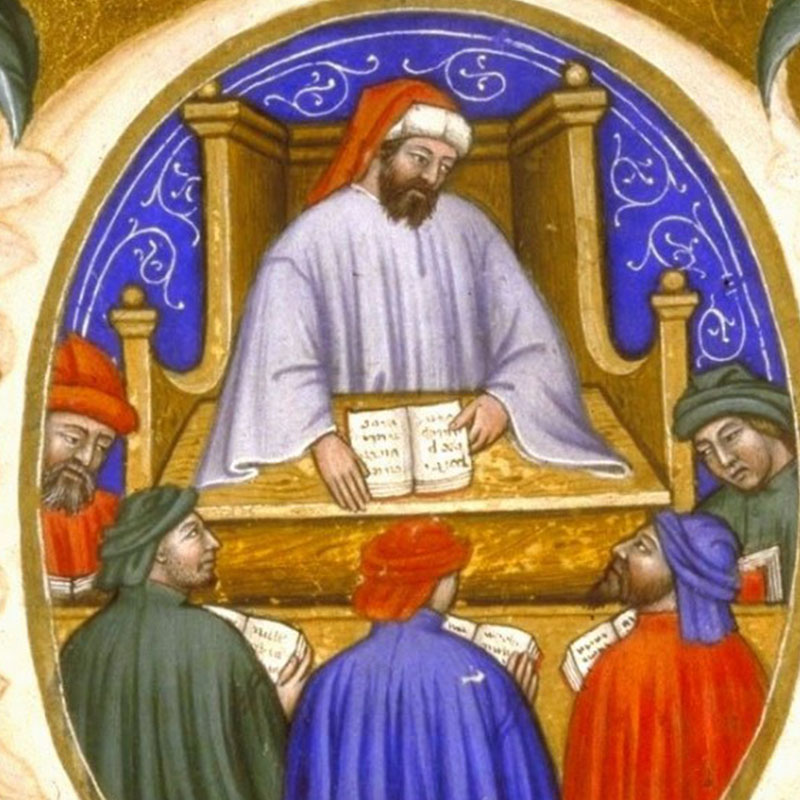
(Unknown. Boethius Initial Consolation Philosophy. Manuscript illumination. 1385. Glasgow University Library, MS Hunter 374. Wikimedia Commons. https://commons.wikimedia.org/wiki/File:Boethius_initial_consolation_philosophy.jpg.)

Born: Circa 480 CE (likely in Rome or Pavia, Italy)
Died: Executed in 524 or 525 CE under the order of Theodoric the Great
Notable
- Composing The Consolation of Philosophy, one of the most influential philosophical texts of the medieval period.
- Translating and preserving key elements of Greek philosophy, especially Aristotelian logic, for the Latin-speaking West.
- Laying foundational ideas for medieval Scholasticism by integrating classical reasoning with Christian doctrine.
- Exploring complex metaphysical and theological issues using rational methods derived from Neoplatonic and Aristotelian traditions.
480 – 525 CE
Biography
Anicius Manlius Severinus Boethius (c. 480 – 524/525 CE) was a Roman philosopher, government official, and Christian thinker who helped bridge the classical and medieval worlds. Born into the distinguished aristocratic family of the Anicii, Boethius received a classical education and became fluent in both Latin and Greek. He held high political office under Theodoric the Great, ruler of the Ostrogothic Kingdom in Italy, eventually attaining the post of magister officiorum, or chief of government administration.
Despite his service to the Gothic regime, Boethius fell from political favor and was imprisoned on charges of treason—likely the result of court intrigue. During his captivity, he composed his most celebrated work, The Consolation of Philosophy, a philosophical dialogue blending classical thought with personal reflection on fate, justice, and divine providence.
Though executed around 524 CE, Boethius’s legacy endured through the Middle Ages and beyond. His writings, particularly on logic, theology, and metaphysics, became central to medieval education and profoundly shaped Christian philosophical thought.
Bibliography & Major Works
Key Works:
The Consolation of Philosophy (De Consolatione Philosophiae, c. 524 CE): A dialogue between Boethius and Lady Philosophy, exploring themes such as happiness, fate, and the nature of good in the midst of personal suffering.
Logical and Philosophical Treatises:
Commentaries on Aristotle’s Categories and On Interpretation.
Latin translations and adaptations of Greek logic, especially the works of Porphyry and Aristotle.
Theological Writings (Opuscula Sacra):
De Trinitate (On the Trinity)
Utrum Pater et Filius (Whether the Father and the Son Are Substantially One)
Contra Eutychen et Nestorium (Refutation of Heresies)
Quomodo Substantiae (How Substances Can Be Good by Existing)
Manuscript Tradition:
The Consolation of Philosophy was copied and studied extensively throughout the Middle Ages. Surviving in hundreds of manuscripts, it remained a core text in monastic, philosophical, and university curricula for centuries.
Influences & Notable For
Composing The Consolation of Philosophy, one of the most influential philosophical texts of the medieval period.
Translating and preserving key elements of Greek philosophy, especially Aristotelian logic, for the Latin-speaking West.
Laying foundational ideas for medieval Scholasticism by integrating classical reasoning with Christian doctrine.
Exploring complex metaphysical and theological issues using rational methods derived from Neoplatonic and Aristotelian traditions.
Famous quotes
“The most miserable kind of misfortune is to have once been happy.” — Consolation of Philosophy, Book II
“Even if one were to try, music cannot be fully separated from the human soul.” — De Institutione Musica
“Genuine happiness lies not in external fortune, but in striving toward the highest good—God.” — Consolation of Philosophy, Book III
Major Works
The Consolation of Philosophy (c. 524 CE):
Book I: Boethius laments his downfall. Philosophy personified appears to console him and challenge his despair.
Book II: Lady Philosophy critiques the instability of Fortune and emphasizes the fleeting nature of worldly rewards.
Book III: The dialogue shifts to defining true happiness as the pursuit of the ultimate good, beyond material success.
Book IV: Discusses the existence of evil and how it fits within a divinely ordered universe.
Book V: Concludes with an exploration of human free will and God’s eternal knowledge.
Other Notable Texts:
De Institutione Musica – A work on music theory rooted in Pythagorean and Platonic traditions.
Opuscula Sacra – Theological treatises addressing the Trinity, divine unity, and heresies.
Legacy & Modern Significance
The Consolation of Philosophy was a dominant text in medieval Europe, often second only to the Bible in popularity and influence.
Boethius’s integration of reason and faith anticipated the method of later Christian philosophers such as Thomas Aquinas.
His logical treatises helped establish the terminology and methods of Scholastic philosophy.
Recognized as a critical figure in the transmission of classical thought to the medieval and modern worlds, he remains essential reading in philosophy, theology, and intellectual history.
Modern Moments & Impact on the 21st Century
810s–present: Ongoing publication and translation of The Consolation of Philosophy, including digital editions accessible through academic platforms.
Modern Academia: Boethius remains a fixture in university courses on medieval thought, logic, and the philosophy of religion.
Popular Influence: References to his thought appear in literature, music, and modern discussions on suffering and meaning.
Contemporary Relevance: His reflections on justice, happiness, and the role of reason continue to resonate in modern philosophical discourse.
Influences & Intellectual Context
Boethius was profoundly shaped by Greek philosophical traditions, especially Platonism, Neoplatonism, and Aristotelian logic.
He aimed to reconcile Greek philosophy with Latin Christian thought, striving to make Plato and Aristotle accessible to the West.
His era was marked by political instability and cultural transition, which framed his mission to preserve classical knowledge amid a changing world.
The educational institutions of the late Roman Empire, combined with Christian theological debates, provided the intellectual backdrop for his work.
Suggested Reading & Resources
Secondary Literature
Chadwick, Henry. Boethius: The Consolations of Music, Logic, Theology, and Philosophy. Oxford University Press, 1981.
Marenbon, John. Boethius. Oxford University Press, 2003.
Magee, John. Boethius on Signification and Mind. Brill, 2010.
Archival and Online Resources
The Consolation of Philosophy, Loeb Classical Library:
https://www.loebclassics.com/view/LCL074/1918/volume.xml
Stanford Encyclopedia of Philosophy:
https://plato.stanford.edu/entries/boethius/
Internet Encyclopedia of Philosophy:
https://iep.utm.edu/boethius/
Project Gutenberg (free English translation):
https://www.gutenberg.org/ebooks/14328
BRIDGE BETWEEN REASON AND FAITH
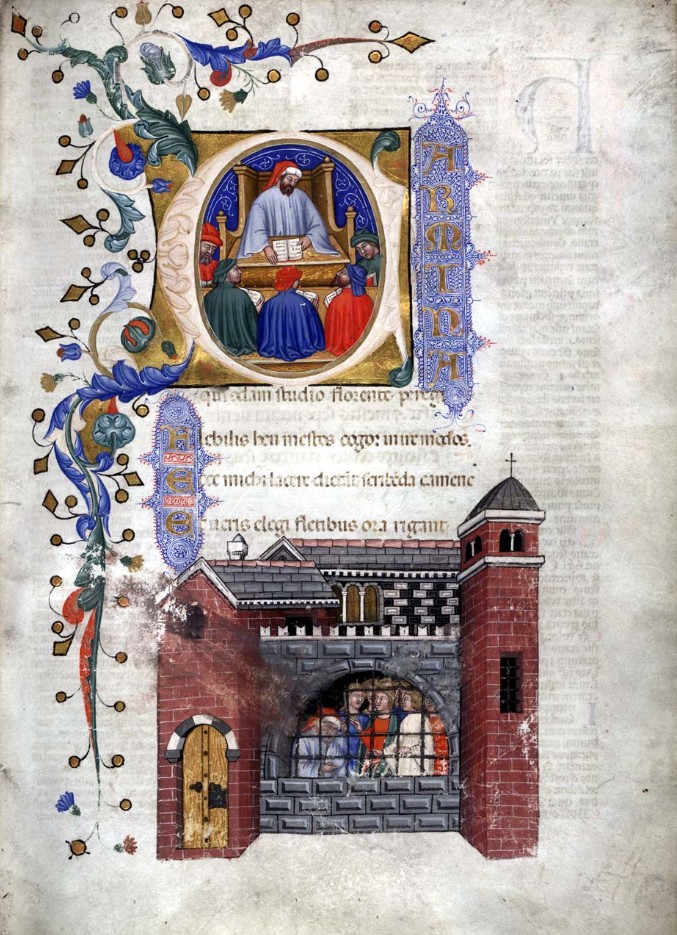
(Gregorius of Genoa. Miniatures of Boethius Teaching and Imprisoned. Manuscript illumination. 1385. University of Glasgow Library, MS Hunter 374. Wikimedia Commons. https://commons.wikimedia.org/wiki/File:Consolation_of_philosophy_1385_boethius_images.jpg.)

A 1385 Italian manuscript miniature from Boethius’s Consolation of Philosophy, illustrating the philosopher both teaching and imprisoned, created by Gregorius of Genoa with scribe Brother Amadeus.
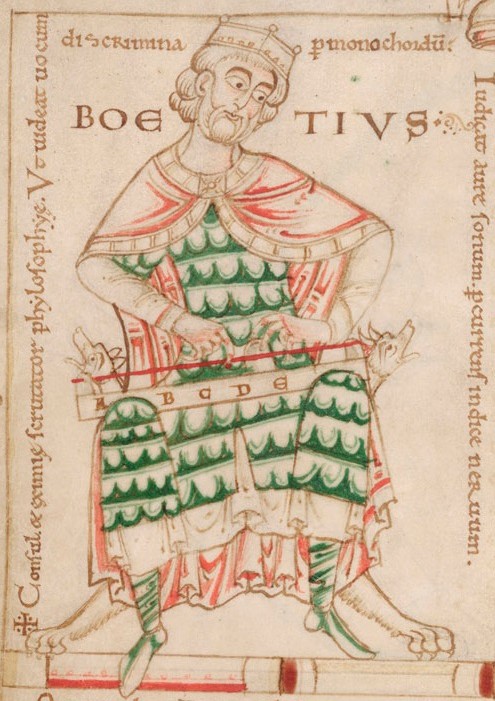
(Unknown. Boethius. Manuscript illumination. ca. early 1100s. Cambridge University Library, MS Ii.3.12. Wikimedia Commons. https://commons.wikimedia.org/wiki/File:Boethius.jpeg.)

A medieval illustration from the early 1100s depicting Anicius Manlius Severinus Boethius, the late-antique philosopher, seated with a monochord, from a Cambridge University Library manuscript.
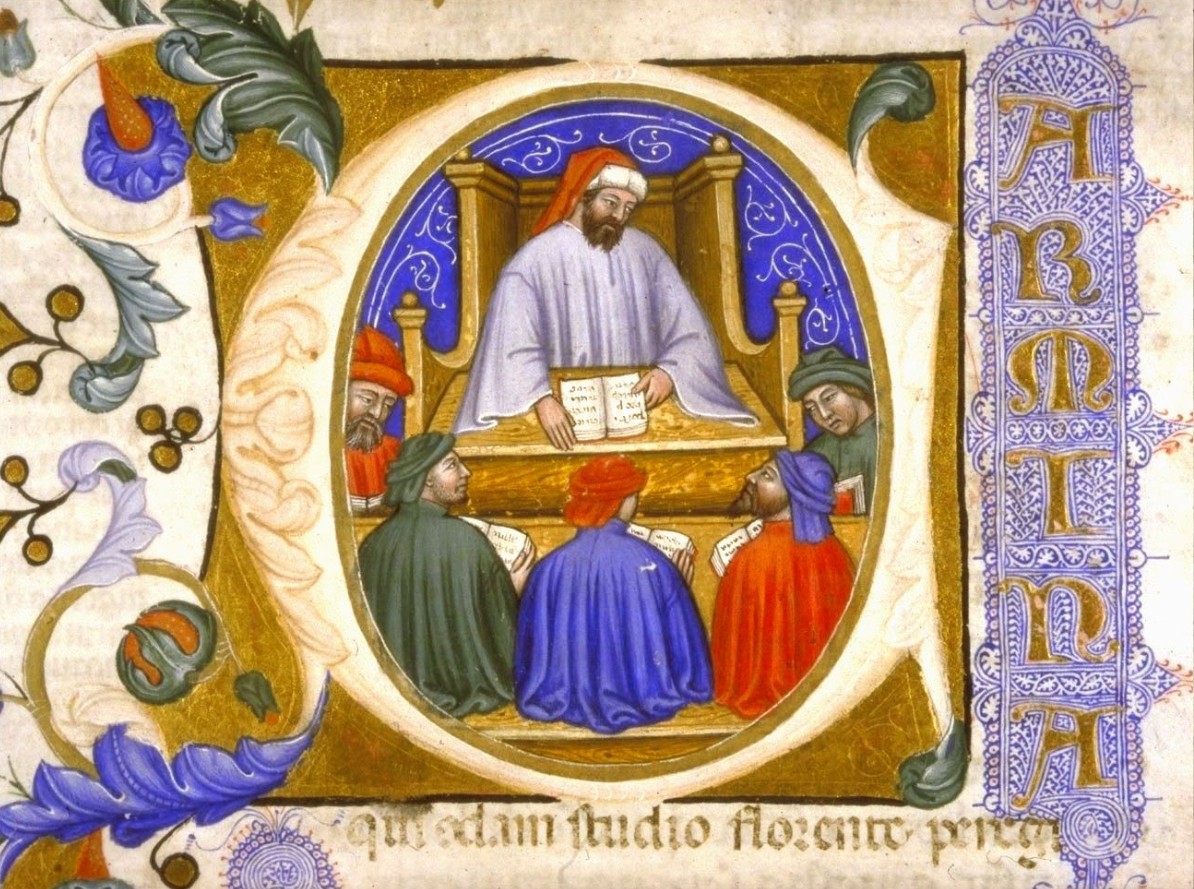
(Unknown. Boethius Initial Consolation Philosophy. Manuscript illumination. 1385. Glasgow University Library, MS Hunter 374. Wikimedia Commons. https://commons.wikimedia.org/wiki/File:Boethius_initial_consolation_philosophy.jpg.)
An illuminated initial from a 1385 Italian manuscript of Consolation of Philosophy, showing Boethius teaching his students, part of MS Hunter 374 at Glasgow University Library.