
AMOS
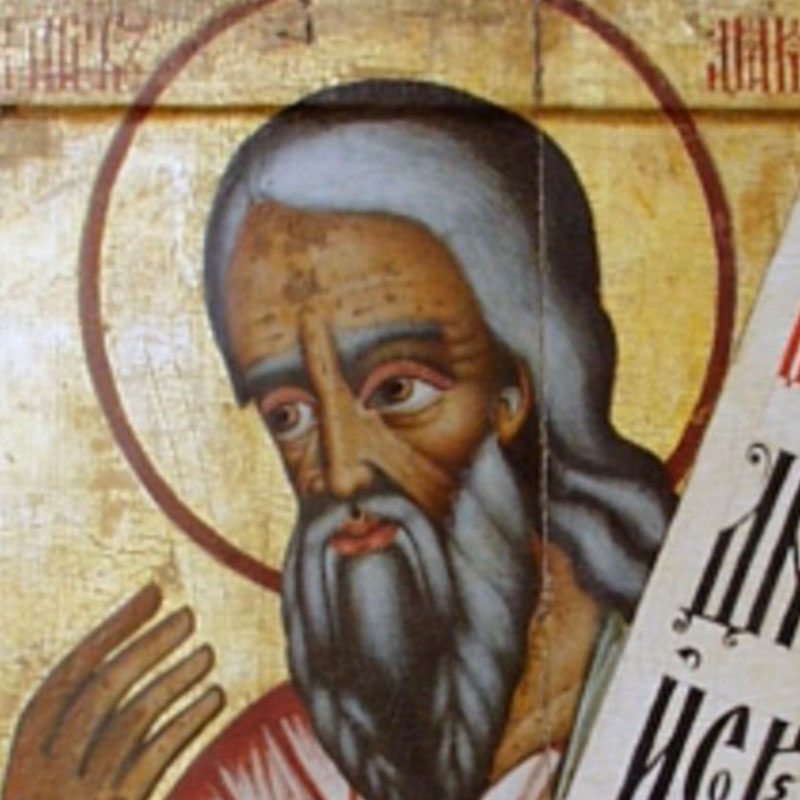
(Amos (prophet).” Wikipedia. Last modified October 15, 2025. “https://en.wikipedia.org/wiki/Amos_%28prophet%29#/media/File:Amos-prophet.jpg.” target=”_blank” rel=”noopener”>https://en.wikipedia.org/wiki/Amos_%28prophet%29#/media/File:Amos-prophet.jpg.)
Born: c. 8th century BCE, Tekoa, Kingdom of Judah
Died: Unknown, likely in the Kingdom of Judah
Notable:
-
Prophetic Voice of Justice: Amos is recognized as one of the Twelve Minor Prophets in the Hebrew Bible, known for his powerful messages condemning social injustice and moral corruption in Israel and Judah.
- Legacy in Social Justice: Amos’ emphasis on justice for the poor and oppressed remains a cornerstone in religious and ethical discussions, inspiring movements for social reform across centuries.
8th Century BCE
Biography
Amos was a prophet from the 8th century BCE, active during the reigns of Uzziah (Judah) and Jeroboam II (Israel) (circa 760–750 BCE). A native of Tekoa, a town in Judah, Amos was not a professional prophet or priest but a shepherd and a dresser of sycamore-fig trees (Amos 7:14–15). Despite his origins in the southern kingdom of Judah, his prophetic mission was directed at the northern kingdom of Israel, particularly criticizing its social injustices, religious hypocrisy, and moral decay. As the third of the Twelve Minor Prophets of the Hebrew Bible, Amos is venerated by both Jewish and Christian faiths.
Amos is regarded as one of the earliest classical prophets in the Hebrew Bible. His messages, preserved in the Book of Amos, emphasize justice, righteousness, and divine judgment. Although not as prominently featured in Christian or Islamic tradition as Moses or Isaiah, Amos’s call for ethical living and social responsibility has made his writings enduringly relevant. Unlike the prophets before him, Amos wrote down all of his messages, resulting in a robust and clear message. Similarly to prophets such as Hosea, Amos reinforced the moral contract between the Israelites and God through prophetic justice. However, Amos prioritized economic justice, stating that ceremonial worship had no intrinsic value compared to service (5:24).
Bibliography / Primary Sources
The Book of Amos (c. 750 BCE): Found in the Hebrew Bible/Tanakh as one of the Twelve Minor Prophets. Composed primarily in poetic oracles, it denounces social corruption, empty worship, and forewarns Israel of impending judgment.
The Dead Sea Scrolls: Fragments of Amos were discovered at Qumran, confirming its ancient textual history.
Septuagint: The Greek translation of the Hebrew Bible includes Amos, showing its influence in early Jewish and Christian communities.
Influences & Notable For
Notable For
First prophetic voice to condemn Israel for injustice rather than idolatry alone.
Spoke against exploitation of the poor, bribery, and judicial corruption.
Emphasized moral behavior over ritual observance, challenging traditional religious complacency.
Predicted the fall of Israel to Assyria (fulfilled in 722 BCE).
Sources: Bible Odyssey, Jewish Virtual Library
Influences
Cultural & Religious Background:
Amos’s ethical critique parallels earlier Near Eastern wisdom and prophetic traditions, but with unique monotheistic urgency.
Precedes Isaiah, Hosea, and Micah, influencing later prophetic literature.
Uses covenantal logic: Israel has broken its agreement with God by forsaking justice.
Historical Context:
Amos prophesied in the Northern Kingdom, during a time of wealth among elites and oppression of the poor.
The rise of Assyria loomed on the horizon, though Israel was still politically strong.
Source: Oxford Biblical Studies – Amos
Famous quotes
- “Let justice roll down like waters, and righteousness like an ever-flowing stream.” – Amos 5:24
- “Woe to those who are at ease in Zion…” – Amos 6:1
- “I hate, I despise your festivals… but let justice roll down…” – Amos 5:21–24
- “Prepare to meet your God, O Israel!” – Amos 4:12
Legacy & Modern Significance
Religious Legacy:
Judaism: Amos is a foundational prophet, emphasizing the ethical demands of the covenant.
Christianity: Quoted in the New Testament and frequently invoked in sermons about justice and mercy.
Islam: While not named in the Quran, prophets like Amos are honored as warners and moral exemplars.
Modern Applications:
Civil Rights Movement: Dr. Martin Luther King Jr. famously quoted Amos 5:24 in his “I Have a Dream” speech.
Liberation Theology: Amos is often cited as a prophet of the oppressed.
Ethics in Politics: Frequently used in political discourse to call out injustice, including by Barack Obama and Desmond Tutu.
Modern Moments & Impact on 21st Century
1963: Martin Luther King Jr. uses Amos 5:24 as a cornerstone of civil rights rhetoric.
2020–2023: Amos quoted during protests for racial justice in the U.S. and global calls for economic equity.
Academic Use: Widely taught in ethics, theology, and political philosophy courses; used in UN human rights seminars and interfaith dialogues.
Faith-Based NGOs: Organizations such as Amos Trust and others use the prophet’s name as a mission statement for peace and justice.
Suggested Reading and Resources
Primary Texts:
Book of Amos – In any standard Bible
Dead Sea Scrolls – Fragments at Israel Museum, Jerusalem
Secondary Literature:
Jörg Jeremias, The Book of Amos (Old Testament Library) – A scholarly commentary.
Daniel J. Carroll, Amos—The Prophet and His Oracles – In-depth study of Amos’s context and message.
James Limburg, Hosea–Micah (Interpretation Series) – A readable, theological commentary.
Walter Brueggemann, The Prophetic Imagination – Explores Amos’s legacy in prophetic consciousness.
ORACLE OF JUSTICE
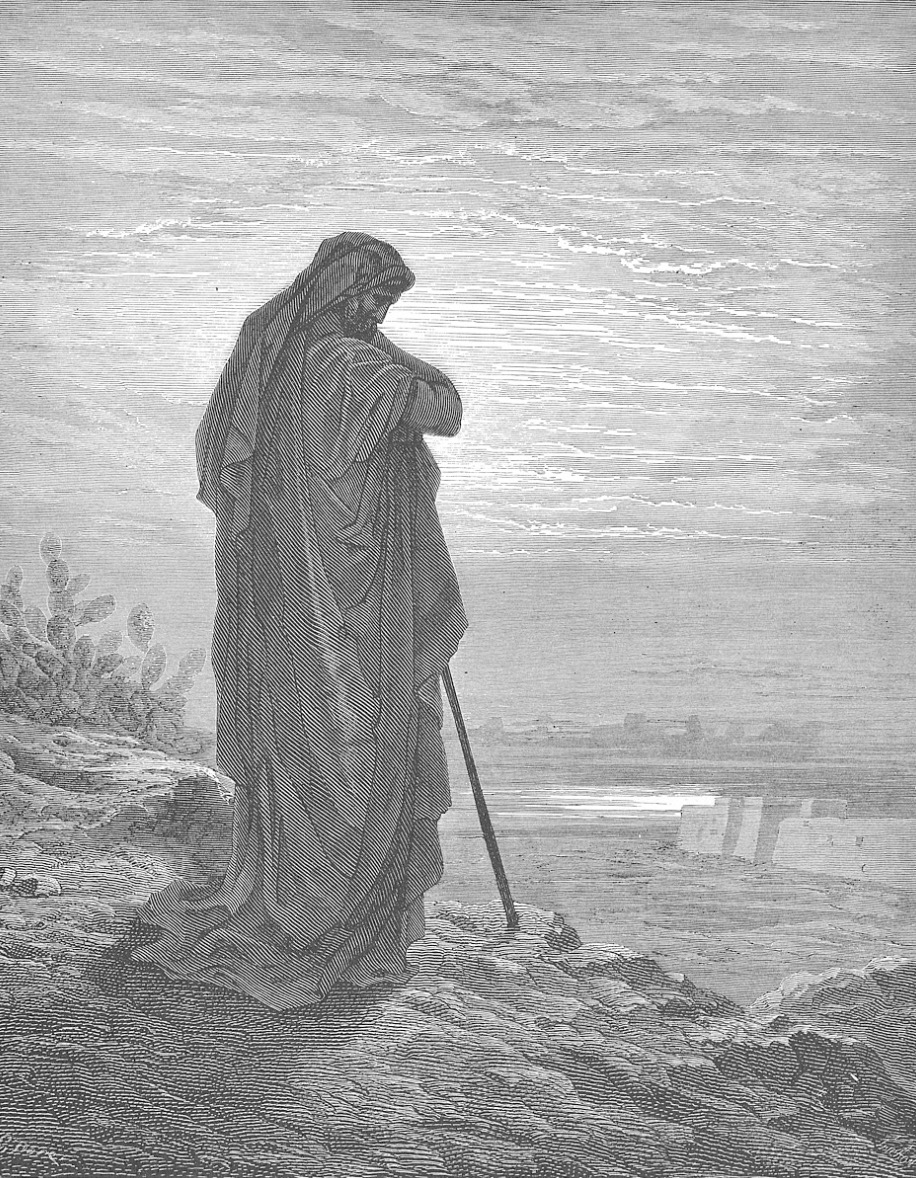
(“Amos, PA08272.jpg.” Wikimedia Commons. Accessed October 5, 2025. https://commons.wikimedia.org/wiki/File:Amos,_PA08272.jpg.)
A 16th-17th century Dutch engraving depicting the biblical prophet Amos in traditional attire, emphasizing his role as a shepherd-prophet.

(Amos – AI-generated image)
The vision of Prophet Amos, standing in awe as a radiant divine figure and celestial beings lower a plumb line from the heavens over a serene valley, signifies his profound role as the Oracle of Justice, delivering God’s call for righteousness and condemning social injustice in ancient Israel.
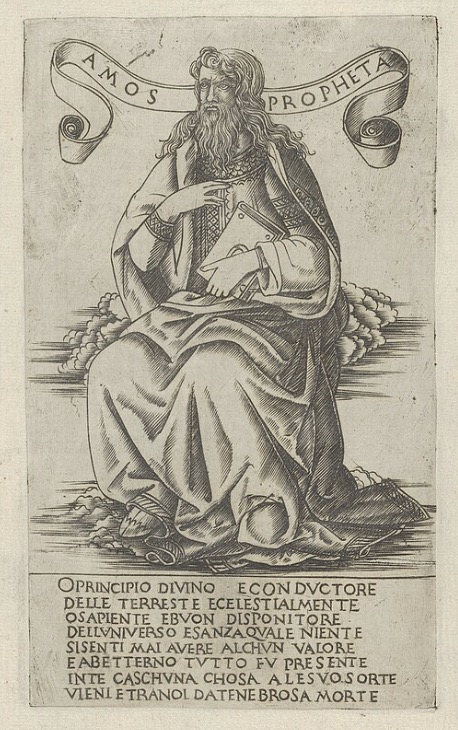
(Rosselli, Francesco, after Baccio Baldini. “The Prophet Amos, from Prophets and Sibyls.” Wikimedia Commons. Ca. 1490. Accessed October 5, 2025. https://commons.wikimedia.org/wiki/File:The_Prophet_Amos,_from_Prophets_and_Sibyls_MET_DP835438.jpg.)
A 15th-century Italian engraving by Francesco Rosselli after Baccio Baldini, showing Amos holding a scroll as one of the prophets and sibyls.