
Ambrose
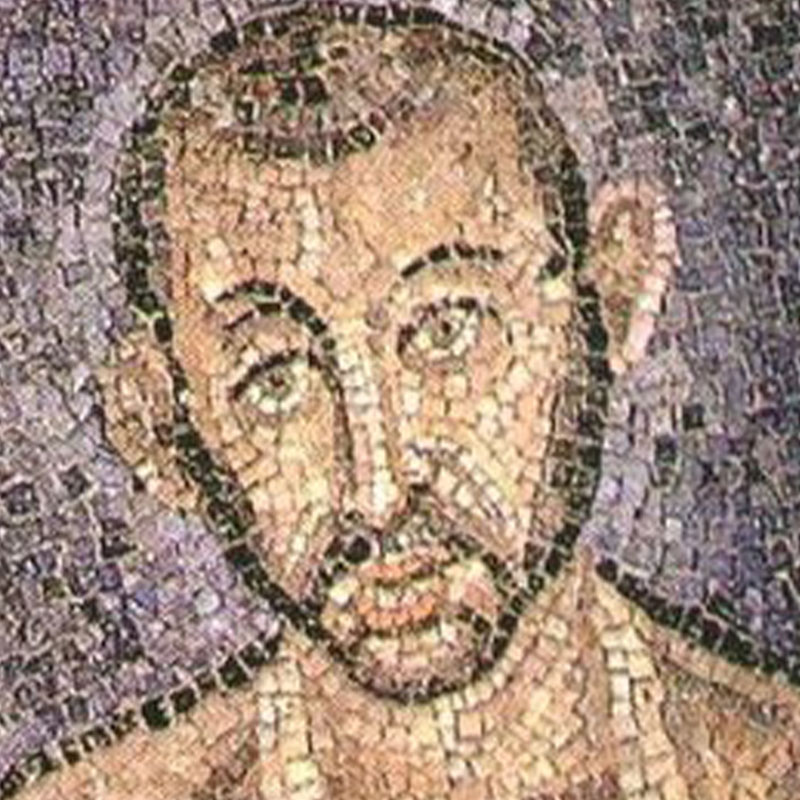
(Unknown mosaicist. “Mosaic of Saint Ambrose.” Mosaic. 4th–5th century CE. Basilica of Sant’Ambrogio, Milan. Wikimedia Commons. https://commons.wikimedia.org/wiki/File:AmbroseOfMilan.jpg.)

Born: Around 340 AD, in Trier, part of Roman Gaul (modern-day Germany)
Died: 397 AD, in Milan, Italy
Notable
- Champion of Church Independence: Ambrose stood firm on the principle that the emperor was subject to the Church in spiritual matters. His most famous confrontation was with Emperor Theodosius, whom he refused to admit to communion until the emperor repented publicly for a massacre.
- Teacher and Thinker: His theological writings helped defend the doctrine of the Trinity, especially the divinity of the Holy Spirit, during ongoing debates with Arian groups.
- Liturgy and Worship: Ambrose helped shape early Christian worship in the West, introducing antiphonal singing (call-and-response chants) and influencing the structure of liturgy that would remain for centuries.
- Mentor to Augustine: Ambrose was instrumental in the conversion of Augustine of Hippo, baptizing him in 387 AD. His influence deeply shaped Augustine’s later theology.
340-397 AD
Biography
Ambrose (circa 340 – 397 AD) was a key figure in the early Christian Church, known for his powerful leadership, theological insight, and bold defense of Christian principles.
Originally a Roman governor with a background in law, he eventually became Bishop of Milan—elected by popular demand before he had even been baptized. Ambrose went on to become a central voice in shaping the role of bishops, setting clear boundaries between Church and imperial power, and promoting orthodox Christian belief during a time of division within the Roman Empire.
Key Themes: The authority of the Church, moral integrity, Christian leadership, biblical interpretation, and the interaction between faith and political power.
Bibliography & Major Works
On the Duties of the Clergy (De Officiis Ministrorum) – A moral guide for church leaders, blending Christian ethics with classical philosophy, especially ideas from Cicero.
On the Sacraments & On the Mysteries – Teachings on baptism and the Eucharist, offering theological foundations for Christian liturgy.
Biblical Commentaries – Reflections on books like Psalms, Luke, and Genesis, focusing on the spiritual meanings within Scripture.
Letters – Nearly 100 letters survive, revealing Ambrose’s thoughts on theology, Church affairs, politics, and personal matters.
Well-Known Translations:
Selected Works and Letters of St. Ambrose – Nicene and Post-Nicene Fathers series
Ambrose: Political Letters and Speeches – Translated by J.H.W.G. Liebeschuetz
Influences & Notable For
-
Champion of Church Independence: Ambrose stood firm on the principle that the emperor was subject to the Church in spiritual matters. His most famous confrontation was with Emperor Theodosius, whom he refused to admit to communion until the emperor repented publicly for a massacre.
-
Teacher and Thinker: His theological writings helped defend the doctrine of the Trinity, especially the divinity of the Holy Spirit, during ongoing debates with Arian groups.
-
Liturgy and Worship: Ambrose helped shape early Christian worship in the West, introducing antiphonal singing (call-and-response chants) and influencing the structure of liturgy that would remain for centuries.
-
Mentor to Augustine: Ambrose was instrumental in the conversion of Augustine of Hippo, baptizing him in 387 AD. His influence deeply shaped Augustine’s later theology.
Famous quotes
“The emperor is in the Church, not above the Church.”
“When in Rome, do as the Romans do.”
“Faith is the beginning of all good works.”
“We are vessels—some for honor, some for lesser use—but all in the hands of God.”
Major Works
|
Title |
Description |
|
On the Duties of the Clergy |
A Christian ethical guide for clergy, inspired by Roman philosophical ideals. |
|
On the Sacraments / Mysteries |
Explains baptism, communion, and other key rites of the Christian tradition. |
|
Biblical Commentaries |
Spiritual interpretations of key biblical texts, emphasizing moral lessons. |
|
Letters |
Covers Church politics, theological debates, and personal counsel. |
Core Themes: Clerical ethics, divine justice, Church authority, spiritual interpretation of Scripture, and the pastoral role of bishops.
Legacy & Modern Significance
Defining Church Leadership: Ambrose set the standard for what a bishop could and should be—courageous, principled, learned, and unafraid to speak truth to power.
Impact on Theology and Worship: His defense of Nicene Christianity helped solidify key doctrines, while his contributions to liturgy left a lasting mark on Western worship practices.
Influence on Augustine: Perhaps Ambrose’s most far-reaching impact was on Augustine, who would go on to become one of the most influential thinkers in Christian history.
Modern Moments & Impact on the 21st Century
Moral Integrity in Leadership: Ambrose remains a model for principled leadership—especially for those in roles where faith and public life intersect.
Church and State Relations: His insistence that the Church has a duty to challenge immoral political actions still resonates in contemporary debates about religion and government.
Lasting Influence: His hymns, liturgical reforms, and theological insights continue to shape Christian tradition, particularly in the Roman Catholic and Western Christian world.
Influences & Intellectual Context
Late Roman Empire: Ambrose lived in a period when Christianity was becoming the official religion of the Empire. As bishop, he navigated conflicts between Christians and pagans, and between different Christian groups (especially Nicene Christians and Arians).
Roman Civic Culture: Coming from a high-ranking Roman family, Ambrose brought a legal and rhetorical background to his Church leadership. His classical education shaped his theological style.
Arian Controversy: A major focus of Ambrose’s career was opposing Arianism, which denied the full divinity of Jesus and the Holy Spirit. He wrote and preached against it vigorously.
Suggested Reading & Resources
Books and Scholarship:
McLynn, Neil B. Ambrose of Milan: Church and Court in a Christian Capital (University of California Press)
Ramsey, Boniface. Ambrose (Routledge, 1997)
Liebeschuetz, J.H.W.G. Ambrose and the Rise of Christian Empire (Oxford University Press)
Online Sources:
St. Ambrose – Writings and Letters – New Advent
Ambrose’s Works (including On the Duties of the Clergy) – Christian Classics Ethereal Library
Digital Texts and Homilies – Internet Archive
DEFENDER OF THE FAITH
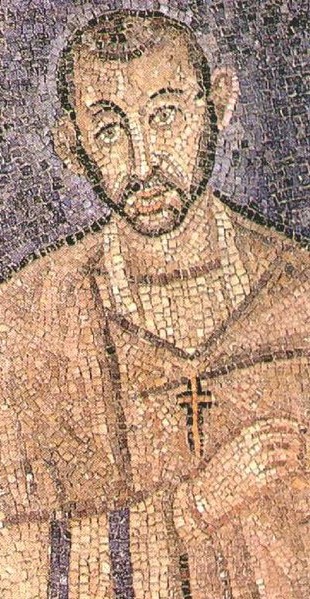
(Unknown mosaicist. “Mosaic of Saint Ambrose.” Mosaic. 4th–5th century CE. Basilica of Sant’Ambrogio, Milan. Wikimedia Commons. https://commons.wikimedia.org/wiki/File:AmbroseOfMilan.jpg.)
A late antique mosaic portrait of Saint Ambrose in the Basilica of Sant’Ambrogio, Milan, possibly a contemporary likeness showing him in episcopal attire with a commanding presence.
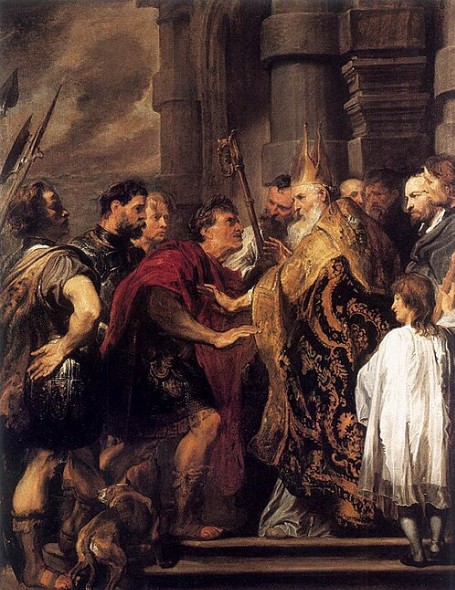
(Van Dyck, Anthony. “Emperor Theodosius Forbidden by Saint Ambrose to Enter Milan Cathedral.” Oil on canvas. Circa 1619–1620. National Gallery, London. Wikimedia Commons.)
A Baroque painting by Anthony van Dyck illustrating Saint Ambrose barring Emperor Theodosius from Milan Cathedral, dramatizing the bishop’s moral authority.
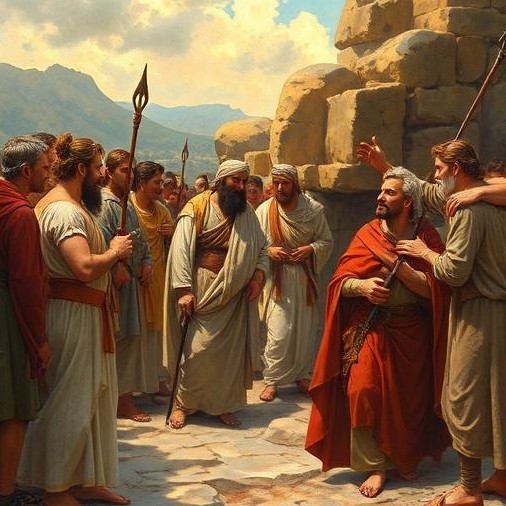
(Ambrose, AI generated)
A classical-style painting depicting Ambrose of Milan, the influential 4th-century bishop and Church Father, addressing a gathering of early Christians. Surrounded by followers and clergy, Ambrose stands confidently in a red cloak, symbolizing his authority and courage in defending the faith. His raised hand and calm expression convey wisdom and conviction, reflecting his role as a teacher, orator, and defender of orthodoxy against heresy. The setting, with ancient stone walls and a radiant sky, evokes the strength and moral clarity that defined Ambrose’s leadership in shaping early Christian doctrine and guiding figures such as Saint Augustine.