
DECLARATION OF INDEPENDENCE
(https://www.archives.gov/founding-docs/declaration)
Adopted: July 4, 1776 (Second Continental Congress, Philadelphia, Pennsylvania)
First Printed: July 4–5, 1776 (Dunlap broadside)
First Signed: (Engrossed Parchment): August 2–19, 1776
Notable
- Declaration of Natural Rights: Asserting that “all men are created equal,” endowed with “unalienable Rights” including “Life, Liberty and the pursuit of Happiness.”
- Universal Appeal: Serving as an enduring statement of democratic principles, later influencing revolutions and constitutional movements worldwide.
Influences & Notable For
The Declaration of Independence (1776), primarily authored by Thomas Jefferson and edited by the Continental Congress, drew heavily from Enlightenment thinkers, especially John Locke’s ideas of natural rights, social contract theory, and the right of revolution (adapted famously from “life, liberty, and property” to “Life, Liberty and the pursuit of Happiness”). It also echoed the Virginia Declaration of Rights by George Mason and broader influences from theorists like Algernon Sidney.
Notable for its eloquent assertion that “all men are created equal” and endowed with unalienable rights, the document served as the founding charter of the United States, justifying separation from Britain through a detailed list of grievances against King George III. It pioneered the modern concept of popular sovereignty and the right to self-government, while its principles have inspired global movements for independence, democracy, and human rights—from the French Revolution to anti-colonial struggles worldwide—making it one of history’s most influential statements on liberty and equality.
Famous quotes
- “We hold these truths to be self-evident, that all men are created equal, that they are endowed by their Creator with certain unalienable Rights, that among these are Life, Liberty and the pursuit of Happiness.”
- “That to secure these rights, Governments are instituted among Men, deriving their just powers from the consent of the governed.”
- “That whenever any Form of Government becomes destructive of these ends, it is the Right of the People to alter or to abolish it, and to institute new Government…”
- “…we mutually pledge to each other our Lives, our Fortunes and our sacred Honor.”
Discussion Questions
- How did John Locke’s theories of natural rights and the social contract in his Two Treatises of Government influence the philosophical core of the Declaration of Independence?
- To what extent did the Declaration of Independence anticipate modern concepts of popular sovereignty, self-determination, and the right of peoples to form independent states?
- How does the Declaration’s justification for revolution and list of grievances compare to earlier documents like the English Bill of Rights (1689) or the Virginia Declaration of Rights (1776)?
- In what ways has the Declaration’s assertion that “all men are created equal” and its emphasis on unalienable rights informed contemporary discussions of human rights, equality, and global democratic movements?
Legacy & Modern Significance
-
Historical and contemporary relevance: The Declaration’s principles of natural rights, equality, and popular sovereignty form the foundation of American democracy and have inspired global human rights and self-determination movements for over two centuries.
-
Documented modern references or adaptations: Its famous phrases appear in the Universal Declaration of Human Rights (1948), numerous national independence declarations, and civil rights rhetoric (e.g., Lincoln’s Gettysburg Address, MLK’s “I Have a Dream” speech referencing the “promissory note” of equality).
-
Current scholarly interpretations and discussions: Scholars debate the shift from its original focus on collective independence to individual equality, its Enlightenment roots versus historical contradictions (slavery, exclusion), and its ongoing influence on debates about democracy, human rights, and global self-determination.
Critical Responses
-
Scholarly debates revolve around the perceived tension between the Declaration’s Enlightenment ideals of universal equality and natural rights and its historical context of slavery, Indigenous dispossession, and exclusion of women and non-property owners.
-
Critical assessments examine the document’s radical justification for revolution versus its limited practical application in the early United States, including debates over whether its principles were aspirational rhetoric or genuine universal claims.
-
Contemporary scholarship reevaluates the Declaration in its historical context, analyzing its implicit assumptions about race, gender, and empire, while exploring how later interpretations expanded “all men are created equal” to fuel abolitionism, civil rights, feminism, and global decolonization movements.
Digital Resources
-
- National Archives (U.S.): Official repository for the Declaration of Independence, including high-resolution images of the engrossed parchment, transcript, and historical context. https://www.archives.gov/founding-docs/declaration
- Library of Congress: Provides digitized early printings, Jefferson’s draft manuscript, and related revolutionary-era documents. https://www.loc.gov/item/90898042/
- Avalon Project (Yale Law School): Full text of the Declaration alongside other foundational American documents with scholarly annotations. https://avalon.law.yale.edu/18th_century/declare.asp
- Monticello.org (Thomas Jefferson Foundation): Features Jefferson’s original draft with editorial changes, plus essays on its creation and influences. https://www.monticello.org/the-declaration
Footnotes
-
- National Archives (U.S.), “Declaration of Independence,” accessed January 2026, https://www.archives.gov/founding-docs/declaration.
- Thomas Jefferson, The Declaration of Independence (Philadelphia: Printed by John Dunlap, 1776).
- Library of Congress, “Jefferson’s Draft of the Declaration of Independence,” accessed January 2026, https://www.loc.gov/item/mtjbib000156/.
- Avalon Project, Yale Law School, “Declaration of Independence,” accessed January 2026, https://avalon.law.yale.edu/18th_century/declare.asp.
- Project Gutenberg, “The Declaration of Independence,” accessed January 2026, https://www.gutenberg.org/ebooks/1.
- Pauline Maier, American Scripture: Making the Declaration of Independence (New York: Knopf, 1997).
- Carl L. Becker, The Declaration of Independence: A Study in the History of Political Ideas (New York: Harcourt, Brace, 1922; Vintage Books ed., 1958).
DECLARATION OF INDEPENDENCE
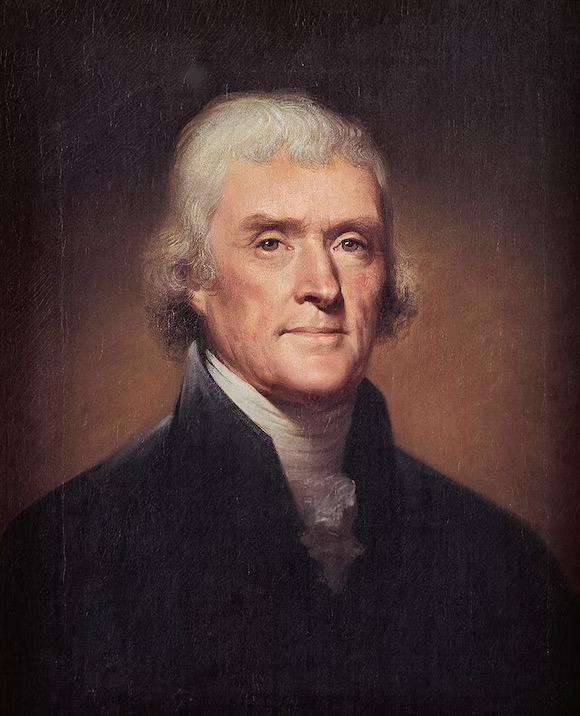
Rembrandt Peale, Thomas Jefferson, oil on canvas, ca. 1800 (or later copy), National Portrait Gallery or similar collection, accessed via National Geographic Kids, https://kids.nationalgeographic.com/history/article/thomas-jefferson
This famous portrait captures Thomas Jefferson, the primary author of the Declaration of Independence, in his prime—symbolizing the intellectual force behind the document’s Enlightenment ideals of liberty and equality.
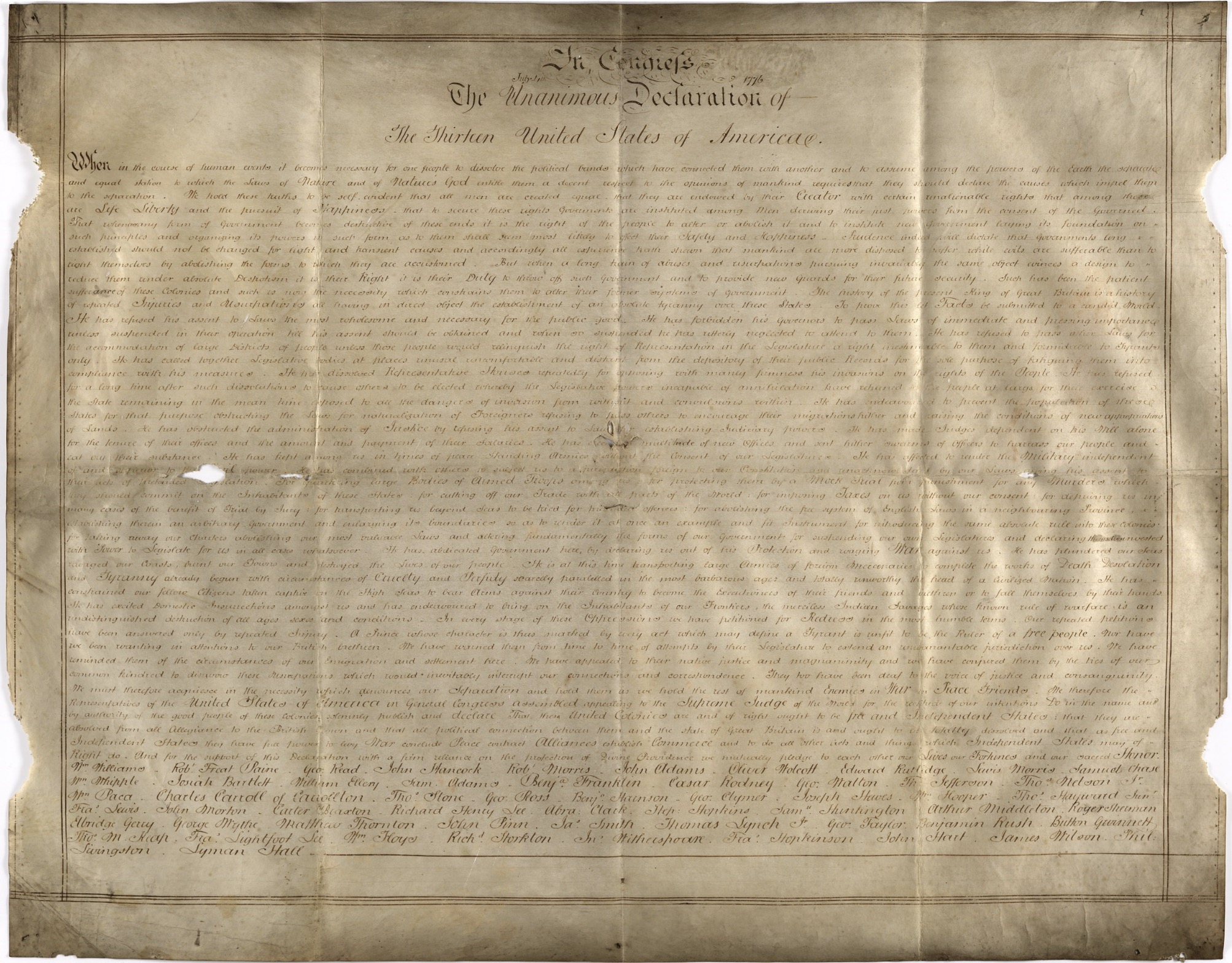
The Declaration of Independence, engrossed parchment, July 4, 1776, National Archives, accessed via William & Mary News, https://news.wm.edu/2022/06/29/the-declaration-of-independence-as-breaking-news-how-word-of-americas-founding-reached-the-atlantic-world
The original engrossed parchment, with its faded ink and elegant script, is the official signed version adopted on July 4, 1776—preserved as a foundational artifact of American independence at the National Archives.
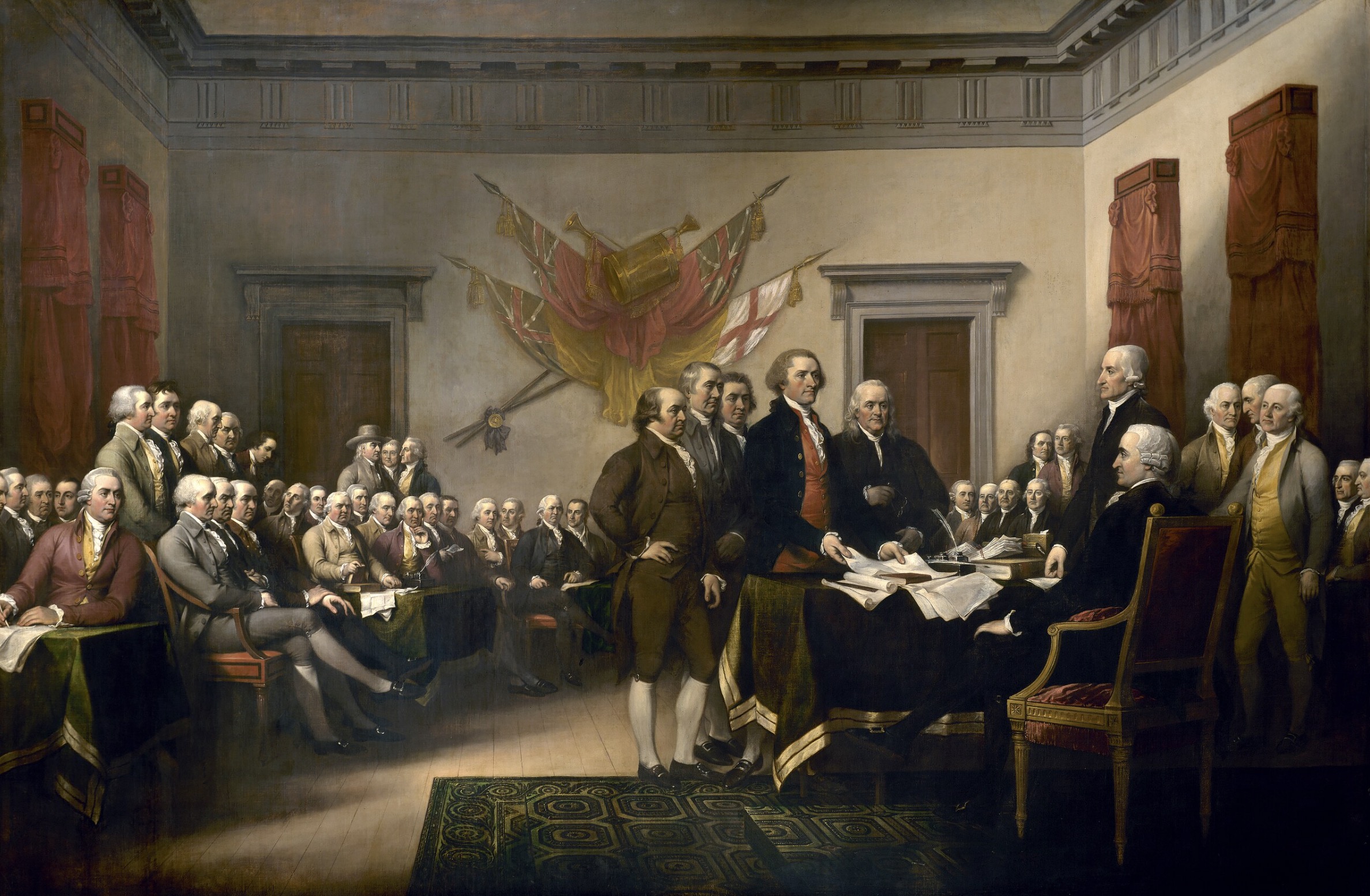
John Trumbull, Declaration of Independence, oil on canvas, 1819, Yale University Art Gallery / U.S. Capitol, accessed via Wikipedia, https://en.wikipedia.org/wiki/Declaration_of_Independence_(painting).
John Trumbull’s iconic 1819 oil painting depicts the presentation of the draft to Congress on June 28, 1776, with Jefferson, Adams, and Franklin central—immortalizing the moment and the 56 signers in a dramatic, heroic composition displayed in the U.S. Capitol Rotunda.